Crafts for Seniors: Simple Projects With Materials Lists
A good craft for an older adult has a short materials list, a finished piece by the end of the afternoon, and a reason to exist: a card to post, a pot for the windowsill, a blanket to give away. These seven projects meet that test. Costs are shown as labels rather than prices, since supply prices vary by store.
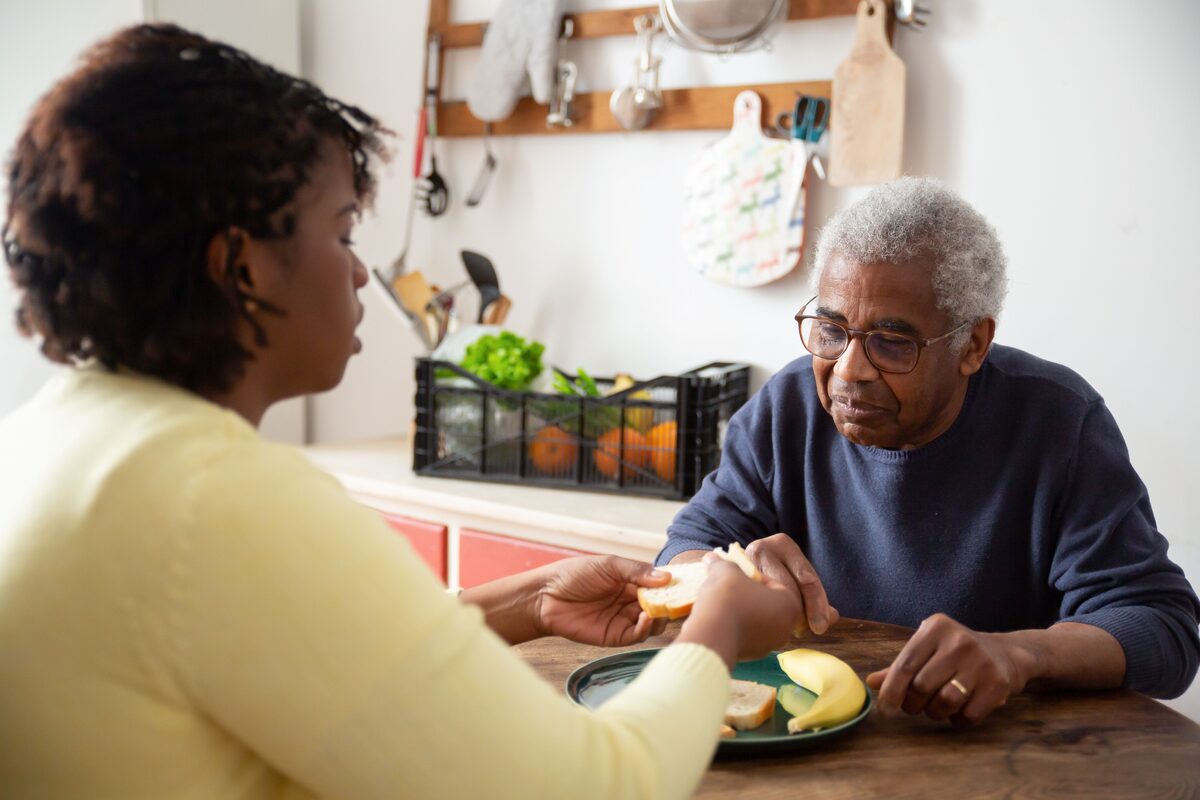
Setting up a craft table for older adults
- Light first. Put the table under a bright lamp or by a window. When vision is low, the National Eye Institute (NEI) recommends extra light and a magnifier for close tasks.
- Contrast. Cover the table with a plain cloth or paper that is a different shade from the materials: dark under white paper, light under dark yarn.
- One project at a time. Lay out only what today's project needs, in the order it is used.
- Chair and height. A firm chair with arms and the work at elbow height eases shoulders and wrists.
- Labeled supplies. Art materials sold in the US must carry a statement such as "Conforms to ASTM D-4236" showing they were reviewed for chronic hazards, under the Labeling of Hazardous Art Materials Act (Consumer Product Safety Commission). Look for it on paints, markers and glues.
Paper crafts for seniors
1. Handmade greeting cards
Folded cards decorated with stamps, stickers, pressed leaves or cut-out pictures, made for birthdays or simply to post to a friend.
Materials: Card stock or heavy paper, envelopes, glue stick, safety scissors, markers, old magazines or used greeting cards to cut up.
Steps:
- Fold card stock in half and crease it with the side of a spoon.
- Choose a picture or cut a shape from an old card or magazine.
- Glue it to the front and press flat for a minute.
- Write a greeting inside, or dictate it to a helper.
- Address the envelope together and post it.
- Approximate cost: Low: household items and basic craft supplies.
- Large-print / low-vision option: Write greetings in thick black marker on white card; use large, bold stickers and pre-printed large-print greetings.
- Make it easier: Pre-fold the cards and pre-cut the pictures, so the task is choosing and gluing.
- Make it harder: Layer several papers, add a pop-up tab, or make a matched set of thank-you cards.
- Safety: Supervise scissors; glue sticks are less messy than liquid glue.
2. Photo memory collage
A board of copied family photos, tickets and clippings around one theme, such as a wedding, a hometown or a career.
Materials: Poster board or a cork board, copies of photos (never the only original), glue stick or pins, markers for captions.
Steps:
- Pick a theme and gather a handful of items.
- Arrange them on the board before gluing anything.
- Fix each item in place.
- Add short captions: who, where, roughly when.
- Hang it where visitors will see it and ask about it.
- Approximate cost: Low: photo copies and a board.
- Large-print / low-vision option: Enlarge photos when copying; write captions in large block letters on light labels.
- Make it easier: Use a ready-made frame with a few openings instead of a large board.
- Make it harder: Build a scrapbook over several weeks, one page per decade.
- Safety: Use pins only with someone who handles small sharp items safely; otherwise use glue or tape.
3. Pressed-flower bookmarks
Flowers or leaves pressed flat, then sealed onto a strip of card for a bookmark or gift tag.
Materials: Fresh flowers or leaves, heavy books, paper towels, card strips, clear self-adhesive sheet or wide clear tape, hole punch and ribbon.
Steps:
- Lay flowers between paper towels inside a heavy book.
- Leave them until fully dry and flat; check after several days.
- Arrange the dried flowers on a card strip.
- Cover with clear adhesive sheet and smooth out air bubbles.
- Trim, punch a hole and tie a ribbon.
- Approximate cost: Free to low: garden flowers and household paper.
- Large-print / low-vision option: Use large, bold blooms and a dark card strip so the flowers stand out.
- Make it easier: Use leaves only and skip the hole and ribbon.
- Make it harder: Make a framed arrangement or a set of matching cards.
- Safety: Check that collected plants are not toxic before handling; the Alzheimer's Association advises removing toxic plants from the home of a person with dementia.
Garden and nature crafts
4. Painted flower pots
Plain clay pots painted with stripes, dots or a name, then planted with herbs or a cutting.
Materials: Small terracotta pots, acrylic craft paint labeled ASTM D-4236, brushes or sponges, newspaper, potting soil, a plant or seeds.
Steps:
- Cover the table with newspaper.
- Paint a base color and let it dry.
- Add a simple design with a sponge, brush end or fingertip.
- Let it dry fully before planting.
- Fill with soil, plant, water and set on a sunny sill.
- Approximate cost: Low to some purchase: pots, paint and a plant.
- Large-print / low-vision option: Choose bright, contrasting paint colors; foam stamps give bold shapes without fine brushwork.
- Make it easier: Sponge-paint one color only and plant together.
- Make it harder: Paint a pattern or lettering, or plant a small herb garden of several pots.
- Safety: Wash hands after soil and paint; keep paint away from anyone who might drink or eat it.
5. Pinecone bird feeder
A pinecone coated in a sticky spread and rolled in birdseed, hung outside a window so the birds can be watched.
Materials: Pinecones, string, a spread such as vegetable shortening or seed butter, birdseed, a tray and a blunt knife.
Steps:
- Tie string around the top of the pinecone.
- Spread the coating over the scales with a blunt knife.
- Roll it in a tray of birdseed.
- Hang it where it can be seen from a favorite chair.
- Keep a simple list of the birds that visit.
- Approximate cost: Low: household items plus birdseed.
- Large-print / low-vision option: Hang it close to the window; a large-print bird chart helps with naming visitors.
- Make it easier: A helper coats the cone; the person rolls it in seed.
- Make it harder: Make several feeders and keep a weekly bird log.
- Safety: Check for nut and food allergies before using nut butters; work over a tray to avoid slips from spilled seed.
Fabric and yarn crafts
6. No-sew fleece tie blanket
Two layers of fleece knotted together along the edges, with no sewing. Finished blankets make good gifts or donations.
Materials: Two pieces of fleece the same size, fabric scissors, a ruler.
Steps:
- Lay one piece on top of the other.
- A helper cuts a square from each corner.
- Cut strips along each edge, about a finger-width wide and a hand-span deep.
- Tie each top strip to the one below it in a double knot.
- Work around all four sides.
- Approximate cost: Some purchase: fleece fabric.
- Large-print / low-vision option: Pick two strongly contrasting colors so each pair of strips is easy to find.
- Make it easier: Make a lap-size blanket; a helper pre-cuts every strip.
- Make it harder: Make a full-size blanket or a set for a charity drive.
- Safety: Sharp fabric scissors stay with the helper if hand strength or judgment is a concern.
7. Yarn-wrapped frame or ornament
Yarn wound around a plain picture frame, a cardboard ring or two crossed sticks, building up stripes of color.
Materials: A flat wooden or cardboard frame, or two craft sticks, yarn in several colors, a dab of glue.
Steps:
- Glue the yarn end to the back of the frame.
- Wrap snugly, keeping rows side by side.
- Change color by gluing a new end over the old.
- Finish by tucking and gluing the last end at the back.
- Add a photo or hang it up.
- Approximate cost: Low: leftover yarn and a basic frame.
- Large-print / low-vision option: Bulky yarn in bright colors is easier to see and handle.
- Make it easier: One color, chunky yarn, a small frame.
- Make it harder: Weave patterns between crossed sticks, or move on to knitting or crochet with a hobby group.
- Safety: Keep loose yarn off the floor where it can trip someone.
Choosing a craft by ability
| If the person... | Try | Why |
|---|---|---|
| Has limited hand strength | Collage, painted pots with sponges, bird feeder | No fine grip or cutting |
| Has low vision | Fleece blanket, yarn frame, bold card stickers | Work is felt as much as seen |
| Tires quickly | Greeting card, bookmark | Finished in one short sitting |
| Wants a longer project | Scrapbook, full blanket, herb garden | Builds over several visits |
| Is living with dementia | Collage, painted pots, folding cards | Simple repeated steps; see the dementia guide below |
The National Institute on Aging lists hobbies such as knitting, painting, wood carving, embroidery and quilting among activities older adults can pursue in groups or alone, and suggests local senior centers, libraries and community colleges for classes. For a person with dementia, the Alzheimer's Association advises keeping projects on an adult level, avoiding anything that seems childlike, using safe materials without sharp tools, and focusing on the process rather than the result; more in activities for people living with dementia.
Crafting with a companion caregiver
Crafts are one of the activities the federal definition of companionship names (29 CFR 552.6), so a companion caregiver can plan them into regular visits. Useful habits: the companion preps fiddly steps before the session, the person makes the choices, and the finished piece goes somewhere it will be seen or given. More visit ideas are in activities a companion caregiver can help with.
Find a companion near you
CaregiverConnect lets you post a companion job for free and hear from caregivers directly; you hire the person yourself, and background checks are not run by CaregiverConnect (safety). The companion care page covers the service; caregiver search lists people near you.
Frequently asked questions
What are easy crafts for seniors?
Greeting cards, photo collages, pressed-flower bookmarks, painted flower pots, pinecone bird feeders, no-sew fleece blankets and yarn-wrapped frames all use few materials and can be finished in one or two sittings.
What crafts work for seniors with arthritis or weak hands?
Choose projects without fine cutting or tight grips: collage with a glue stick, sponge-painting pots, or rolling a pinecone in seed. Thick brushes and bulky yarn are easier to hold. You can also ask the person's doctor whether an occupational therapist could suggest adapted tools.
Are craft paints safe for older adults?
Look for a label such as "Conforms to ASTM D-4236". Under the Labeling of Hazardous Art Materials Act, art materials sold in the US need that statement and must be reviewed for chronic hazards, with warning labels where a hazard exists (Consumer Product Safety Commission).
What crafts can someone with low vision do?
Tactile projects such as fleece tie blankets and yarn wrapping, with strong color contrast and bright light. NEI also recommends extra light and magnifiers for close-up tasks.
Do crafts help people with dementia?
The Alzheimer's Association says art projects can create a sense of accomplishment and purpose and give room for self-expression. Keep projects adult in style, use safe materials and do not worry about finishing. This page does not claim that any craft treats, slows or prevents dementia.
Sources
- Consumer Product Safety Commission, Art Materials business guidance (LHAMA, ASTM D-4236)
- National Eye Institute, Low Vision
- National Institute on Aging, Participating in Activities You Enjoy As You Age (web.archive.org capture, July 30, 2026)
- Alzheimer's Association, Art and Music
- Alzheimer's Association, Home Safety
- 29 CFR 552.6, Companionship services (LII, Cornell Law School)
Ready to find a caregiver?
Post what you need for free and see which caregivers near you apply.