Easy-to-Use Thermometers for Seniors
Every home with an older adult needs one thermometer that the person, or whoever helps them, can use and read without fuss. The trade-off is between ease and accuracy, and the method used changes what counts as a normal number. This guide compares the main types, sets out the FDA's instructions for no-touch thermometers, and lists the points at which MedlinePlus says an adult with a fever should contact a provider.


Who may benefit from an easier thermometer
A thermometer is a basic household item, but the standard kind can be hard to use for someone with poor eyesight, a tremor, a dry mouth, or memory problems that make it hard to keep a probe under the tongue for minutes at a time. A larger display or a different method may make regular checks practical. Situations where an easier thermometer may help include:
- recovering at home after a hospital stay or surgery, when the care team has asked for temperature checks;
- living with a long-term condition such as heart or lung disease or diabetes, which MedlinePlus lists among reasons for an adult with a fever to contact a provider promptly;
- having a caregiver who checks on the person during cold and flu season.
Ask the doctor, nurse or pharmacist which method they want used, what reading should prompt a call, and whether any medicine the person takes for pain or fever could mask a temperature. If vision is the barrier, an eye doctor or low-vision specialist may suggest other aids.
How we wrote this guide
No thermometer was tested for this page. We have no affiliate links, accept no paid placement and do not rank or recommend brands. The information comes from the FDA's page on non-contact infrared thermometers, the National Library of Medicine's MedlinePlus encyclopedia (temperature measurement, body temperature norms and fever), the EPA's page on mercury thermometers and Medicare.gov.
Types of thermometer compared
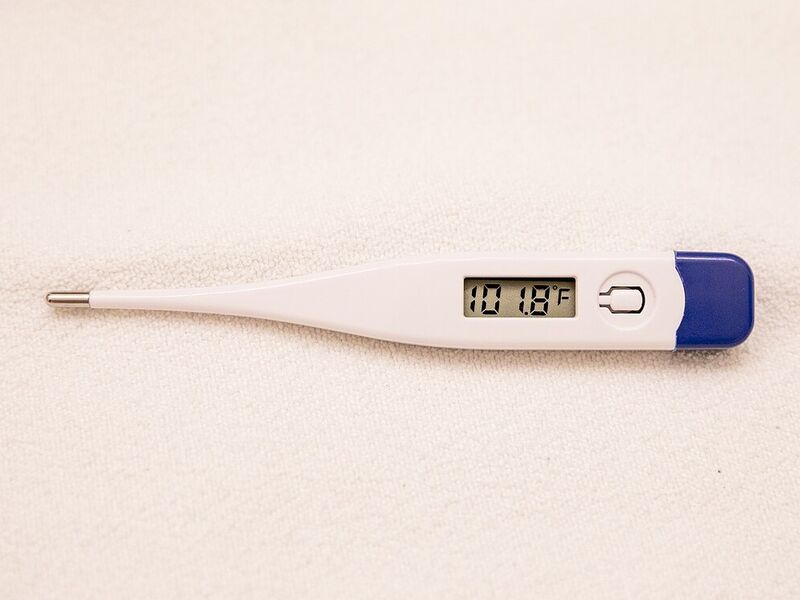
| Type | Where it reads | Accuracy and notes (as the sources put it) | Ease for an older adult |
|---|---|---|---|
| Digital stick (probe) | Under the tongue, or in the armpit | Electronic thermometers are the type MedlinePlus says is most often suggested. Oral: about 3 minutes or until it beeps. Armpit: about 5 minutes; usually reads a little lower than oral | Cheap and simple, but the person must keep the mouth closed and breathe through the nose |
| Ear (tympanic) | Inside the ear canal | Easy to use, but MedlinePlus says some users find it less accurate than probe thermometers; tends to read a little higher than oral | Fast; needs a correct fit in the ear |
| Forehead (temporal), touching skin | Swept or placed on the forehead | MedlinePlus says electronic forehead thermometers are more accurate than ear types and similar to probe thermometers; often reads a little lower than oral | No need to hold anything in the mouth |
| Non-contact infrared (no-touch) | Held near the forehead | The FDA says how and where it is used affects the reading; follow the maker's distance and room conditions | Quick and needs no contact, but technique matters |
| Plastic strip | On the forehead | Least accurate, measures skin rather than body temperature, and not recommended for general home use (MedlinePlus) | Easy, but not reliable enough to act on |
| Glass mercury | Mouth, armpit | MedlinePlus repeats the American Academy of Pediatrics' advice not to use them: the glass can break and mercury is a poison | Hard to read; replace with a digital type |
Thermometers have no weight capacity to compare. The "size" that matters is the display: check the digit height, backlight and beep on the box, and try it in a dim room if you can.
How to choose an easy-to-use thermometer
- Match the method to the person. If keeping a probe in the mouth for minutes is hard, a forehead or ear type may be easier. If the clinician wants oral readings, ask whether another method is acceptable.
- Read it in real conditions. A large, backlit screen and a clear beep at the end help someone with low vision or hearing loss. The EPA says to choose a thermometer that is easy to use and read.
- Batteries. The EPA advises picking a battery-powered digital model with a replaceable battery. Those small button cells can contain a little mercury, so it says to recycle them through hazardous waste collection.
- Keep one method. MedlinePlus says to tell the provider which method you used, because ear, armpit, forehead and oral readings differ. Sticking to one type makes a log easier to read.
- Retire the old glass thermometer. The EPA lists at least 13 states with laws against making, selling or distributing mercury fever thermometers, and says mercury-free digital ones are similar in use.
Using a no-touch forehead thermometer correctly
The FDA's page on non-contact infrared thermometers lists what the instructions for use typically include. The main points:
- Use it in a room without drafts, out of direct sun and away from heaters.
- Room conditions typically need to be between 60.8 and 104°F (16 to 40°C) with relative humidity below 85 percent. Let the thermometer sit in the room for 10 to 30 minutes first so it can adjust.
- The forehead should be clean, dry and uncovered. Hats, headbands, heavy clothing and face wipes can push the reading up or down.
- Hold the sensor straight on to the forehead, at the distance in that model's instructions, and ask the person to keep still.
- Keep the sensor clean and dry, and do not dunk the thermometer in water; follow the cleaning section of its manual.
For any thermometer, MedlinePlus advises waiting at least an hour after heavy exercise or a hot bath, and 20 to 30 minutes after smoking or a hot or cold drink, before taking a reading. Clean it before and after use with cool soapy water or rubbing alcohol, unless the manual says otherwise.
Cost, coverage and upkeep
We give no prices here; the EPA describes battery and solar digital thermometers as similar in price and use to the mercury kind they replace. They are not on the list of durable medical equipment on Medicare.gov's DME page (archived copy of 2026-10-23), which describes DME as items typically only useful to someone sick or injured and built to last three years or more. When Original Medicare does not cover an item, the cost falls to you unless other insurance helps, Medicare.gov explains; Medicare Advantage, cost plans and PACE may cover some extra benefits, so a plan's over-the-counter benefit is worth asking about. Upkeep is cleaning after each use, a spare battery and, for ear types, any probe covers the maker specifies.
What counts as a fever in an older adult, and when to call
Normal temperature varies. MedlinePlus and the FDA both say that 98.6°F (37°C) is the usual average, but normal can range from about 97°F (36.1°C) to 99°F (37.2°C). MedlinePlus says it is lowest early in the morning and often highest in the evening. Its fever article says an adult probably has a fever when an oral reading is above 99 to 99.5°F (37.2 to 37.5°C) depending on the time of day, and its temperature-norms article says a reading over 100.4°F (38°C) most often means a fever from infection or illness.
MedlinePlus says an adult should contact a provider right away if they:
- have a fever of 105°F (40.6°C) or more that does not come down readily with treatment;
- have a fever that stays at or keeps rising above 103°F (39.4°C), or lasts longer than 48 to 72 hours;
- have had fevers come and go for up to a week or more, even low ones;
- have a serious illness such as a heart problem, diabetes, COPD or another long-term lung problem, or a weakened immune system;
- have a new rash or bruises, pain when urinating, or recent travel abroad.
It says to call 911 if a person with a fever cannot be woken easily, seems confused, cannot walk, has trouble breathing, has blue lips, tongue or nails, a very bad headache, a stiff neck or a seizure. The person's own clinician may set a different threshold; follow theirs.
Limitations and safety
- A thermometer shows one number. MedlinePlus notes that some serious infections cause no fever, or even a very low temperature, and that a temperature too high or too low can be serious. How the person seems matters as much as the reading.
- Readings from different methods are not interchangeable; MedlinePlus calls the exact relationship between them unclear.
- A no-touch thermometer used outdoors, in sunlight or at the wrong distance can read wrongly, the FDA cautions.
- A broken mercury thermometer releases vapor that the EPA calls harmful, so follow the EPA's instructions for clean-up and disposal if an old one breaks.
How a caregiver can help
- Keep the thermometer, spare battery and a log sheet together, somewhere easy to reach.
- Use the same thermometer and method each time, and note which one on the log.
- Take readings at a consistent time when checks have been requested, and record the time with each one.
- Write the provider's "call us if" number at the top of the log.
- Watch for the warning signs listed above, and tell the family or clinician about changes in eating, drinking or alertness.
For someone who lives alone, regular visits from a companion caregiver can add these checks to the day; if help with bathing or dressing during an illness is needed, see personal care. Job listings on CaregiverConnect are free for families, who hire the caregiver themselves. Background checks are not done by us, so work through our safety steps. To begin, find a caregiver near you.
Frequently asked questions
What is the easiest thermometer for an elderly person to use?
That depends on the person. Forehead and ear types avoid holding a probe in the mouth, and MedlinePlus says electronic forehead thermometers are more accurate than ear ones and similar to probe thermometers. Look for a large, clear display and a beep.
Are no-touch forehead thermometers accurate?
The FDA says the reading depends on how and where they are used, including room temperature, sunlight, head coverings and distance. Follow that model's instructions closely and let it adjust to the room for 10 to 30 minutes first.
What temperature is a fever for a senior?
MedlinePlus says an adult probably has a fever when an oral reading is above 99 to 99.5°F, and that over 100.4°F most often means a fever from infection or illness. Ask the person's clinician what number should prompt a call.
Should we still use a mercury thermometer?
No. MedlinePlus repeats the American Academy of Pediatrics' advice against glass mercury thermometers because the glass can break and mercury is a poison, and the EPA says mercury-free digital thermometers are a similar alternative.
Does Medicare pay for a thermometer?
Thermometers do not appear on the Medicare.gov list of covered durable medical equipment. Some Medicare Advantage plans include extra benefits, so check with the plan.
Why do ear and forehead readings differ from oral ones?
Each method measures a different place. MedlinePlus says ear readings are usually 0.5 to 1°F higher than oral, and forehead scanner and armpit readings usually 0.5 to 1°F lower. Tell the provider which method you used.
Sources
- FDA, Non-contact infrared thermometers
- MedlinePlus (NIH/NLM), Temperature measurement
- MedlinePlus (NIH/NLM), Body temperature norms
- MedlinePlus (NIH/NLM), Fever
- U.S. EPA, Mercury thermometers
- Medicare.gov, Durable medical equipment (DME) coverage (archived copy, 2026-10-23)
- Medicare.gov, What's not covered by Original Medicare
Ready to find a caregiver?
Post what you need for free and see which caregivers near you apply.