Blood Pressure Monitors for Seniors: Choosing and Using One at Home
A home blood pressure monitor gives an older adult and their clinician a run of readings taken in ordinary life rather than one number from a busy office. The device only helps if the cuff fits and the reading is taken the right way. This guide covers the types, how to choose one, the routine the American Heart Association and the CDC describe, and where a family member or caregiver fits in.


Who may benefit from a home blood pressure monitor
The American Heart Association (AHA) recommends home monitoring for everyone who has high blood pressure, so their clinician can tell whether treatment is working. The AHA also names people who are starting or changing blood pressure treatment, and people who need closer monitoring because of risk factors or related conditions. The CDC calls this self-measured blood pressure (SMBP) monitoring and says people with high blood pressure are more likely to lower it when they combine SMBP with support from their health care team than when they do not.
Before buying, it may help to ask:
- The doctor or nurse: how often to measure, what numbers should prompt a call, and whether home readings are wanted at all.
- A pharmacist: the AHA suggests asking a pharmacist or clinician which validated monitor suits the person.
- An occupational therapist: if arthritis, a tremor or weakness after a stroke makes putting on a cuff hard, an OT may suggest ways to manage it.
Only a doctor or other clinician can confirm a high blood pressure diagnosis, the AHA notes. A home monitor is a measuring tool, not a diagnosis.
How we wrote this guide
We have not tested any blood pressure monitor. We earn nothing from this page: no affiliate links, no paid placement, and no brands or models ranked or recommended. The guidance comes from the American Heart Association's home monitoring page, the CDC's page on measuring blood pressure, and Medicare.gov's durable medical equipment pages, plus the federal assistive technology program run through the Administration for Community Living. Where those sources say to ask a clinician, so do we.
Types of blood pressure monitor compared
| Type | How it works | What the cited sources say | Size and features to check |
|---|---|---|---|
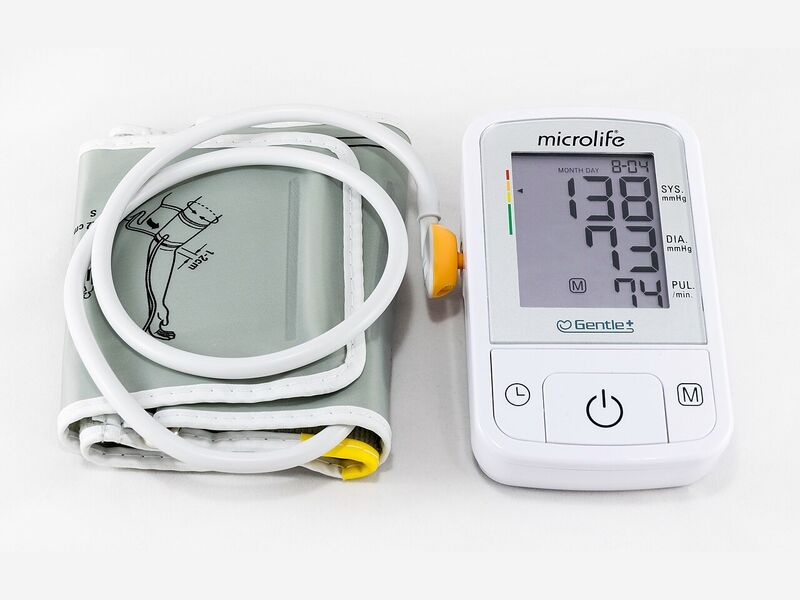
| Automatic upper-arm cuff | A cuff on the bare upper arm inflates and deflates by itself; a screen shows the numbers | The type the AHA recommends for home use | Cuff range (check the label for the arm circumference it fits), screen size, memory, one or two user profiles |
| Wrist monitor | A small cuff wraps the wrist | The AHA says wrist monitors give less reliable readings and does not recommend them | Not advised by the AHA; ask a clinician if an upper-arm cuff is impossible to fit |
| Finger monitor | A sensor on a fingertip | Also not recommended by the AHA, for the same reason | Not advised by the AHA |
| Manual cuff with gauge | A cuff is pumped by hand and the reader listens with a stethoscope while releasing air | The CDC describes this as the way a clinician takes a reading; a digital cuff needs no stethoscope | Needs training and good hearing; rarely the easiest choice for home use |
| Pharmacy kiosk | A sit-down digital machine in a pharmacy | The CDC lists it among the places to get a reading | Useful for occasional checks; it cannot give a daily record at home |
A blood pressure cuff has no weight limit. What matters is arm size: a cuff that is the wrong size gives an inaccurate reading, according to the AHA. The circumference range is printed on the cuff or the box, so check the label against a tape measure before you buy.
How to choose a blood pressure monitor for an older adult
- Measure the arm first. Wrap a soft tape around the middle of the bare upper arm and write down the number. Pick a monitor whose cuff range covers it, or one sold with a larger or smaller cuff.
- Look for validation. The AHA advises a validated monitor and says that, for a senior, you should make sure it has been validated for that group. It points shoppers to the validated device list at validatebp.org, or to a pharmacist or clinician.
- Check the controls. One large start button, a big high-contrast screen and a cuff with a ring or loop that can be tightened with one hand are worth looking for if the person has arthritis or poor eyesight. Read the manual's diagrams before you buy if you can.
- Decide how readings will be recorded. The AHA says built-in memory lets you bring stored readings to appointments, and some monitors upload to a secure website. A paper log works just as well; the CDC suggests keeping one.
- Think about power. Check whether it runs on batteries, a plug-in adapter or both, and keep spare batteries with it.
How to take an accurate blood pressure reading at home
The AHA and CDC give closely matching routines. In short:
- Thirty minutes before: no smoking, caffeine, exercise, food or drink. The AHA also suggests emptying the bladder.
- Five minutes of rest: sit in a chair with the back supported, feet flat and legs uncrossed, without talking or using the phone.
- Arm position: rest the arm on a table so the middle of the cuff is level with the heart. A pillow under the arm can raise it.
- Cuff on bare skin: never over a sleeve. The AHA places the lower edge just above the bend of the elbow; the CDC says the cuff should be snug but not too tight.
- Two readings: the AHA advises two readings one minute apart, at the same time each day, written down each time.
Either arm can be used, the AHA says, as there is usually little difference between them. Once the monitor is bought, take it to the next appointment so the clinician can watch the technique and compare it with the office equipment. The AHA suggests repeating that check about once a year, or as the maker directs.
Costs, Medicare and other help paying
Medicare.gov defines durable medical equipment (DME) as items that are durable, used for a medical reason, generally of use only to a person who is ill or hurt, used at home and expected to last at least three years. Its list of covered DME, as archived on 2026-10-23, includes items such as glucose monitors, walkers and oxygen equipment, but does not list home blood pressure monitors. Original Medicare does not cover every item, and its "What's not covered" page says you pay for those yourself unless other coverage helps.
- Medicare Advantage, cost plans and PACE: Medicare.gov says these may include extras that Original Medicare lacks; check with the plan about a home monitor or an over-the-counter allowance.
- State assistive technology programs: the federal AT Act funds one in each state through the Administration for Community Living. Their activities include device loan, reuse and demonstration, so it is worth asking whether a monitor can be tried before buying. The AT3 Center lists each state's program.
- Pharmacy machines: the CDC lists a pharmacy's digital machine as one place to get a reading if a home monitor is not affordable yet.
We give no prices here. For upkeep, follow the manual's storage and battery instructions and have the readings checked against the clinic's equipment as described above.
Limitations and safety
- It does not replace visits. The AHA says home monitoring does not replace regular doctor visits, and that nobody should stop blood pressure medicine because of home readings without checking with their clinician.
- One number is a snapshot. A single high reading is not, by itself, cause for alarm, the AHA says: take a second reading, write both down, and check with the clinician if it persists.
- Very high readings: if a reading is higher than 180/120 mm Hg, the AHA says to wait at least a minute and test again, and to contact the clinician immediately if it is still that high. If that level comes with chest pain, shortness of breath, back pain, numbness, weakness, a change in vision or difficulty speaking, the AHA says to call 911.
- Readings can mislead either way. The CDC notes that nerves at the office, recent caffeine or exercise, crossed legs or a dangling arm can push a reading up. A falsely low reading may give false reassurance.
- Office versus home. As many as 1 in 3 people with a high reading at the doctor's office may have normal readings outside it, according to the CDC. That is one reason clinicians ask for home logs.
How a caregiver can help with daily blood pressure checks
- Set up a "reading spot": a chair with a back, a table at the right height, the monitor, a pen and the log, all kept in one place.
- Pick a fixed time that fits the routine the clinician asked for, before morning coffee if readings are taken then.
- Help with the cuff if fingers are stiff, and check that it sits on bare skin with the tube in the right position.
- Keep the room quiet for the rest period; save conversation for after the second reading.
- Write down both readings, the date, the time and anything unusual, such as a missed dose or a poor night's sleep.
- Know the plan: which numbers mean "call the office" and which mean "call 911", written on the log sheet.
- Bring the monitor and log to appointments.
Many families hire help for this kind of daily routine. A companion caregiver can keep the schedule, write down readings and prompt other health habits, and the medication reminders page explains how caregivers fit into a medicine routine. If moving between rooms is the hard part, see mobility assistance, and companion vs. personal care explains which kind of help fits. There is no fee to post the job on CaregiverConnect. You do the interviewing and hiring yourself, and because we run no background checks, use our safety checklist. To start, find a caregiver near you.
Frequently asked questions
What type of blood pressure monitor is best for elderly people?
The American Heart Association recommends an automatic upper-arm cuff that has been validated, and says to make sure it is validated for seniors. It does not recommend wrist or finger monitors because their readings are less reliable.
How do I know which cuff size to buy?
Measure around the middle of the bare upper arm and match it to the arm range printed on the cuff or box. The AHA warns that a cuff of the wrong size gives an inaccurate reading.
Does Medicare pay for a home blood pressure monitor?
Home blood pressure monitors are not on the durable medical equipment list Medicare.gov publishes, and Original Medicare does not cover everything. Some Medicare Advantage plans offer extra benefits, so ask the plan directly.
Why is my home reading different from the doctor's office?
The CDC says nerves at the office, recent caffeine or exercise, and posture can all change a reading, and that up to 1 in 3 people with a high office reading may be normal elsewhere. Take the monitor to an appointment so the clinician can compare it with theirs.
How often should a senior check their blood pressure at home?
Ask the clinician. The AHA suggests taking readings at the same time each day, two readings a minute apart, and the CDC says people with high blood pressure may need to measure more often than others.
What reading means we should call 911?
The AHA says to call 911 if a reading is above 180/120 mm Hg and the person has chest pain, shortness of breath, back pain, numbness, weakness, a change in vision or trouble speaking. Without those symptoms, retest after a minute and call the clinician right away if it stays that high.
Sources
- American Heart Association, Monitoring your blood pressure at home (web.archive.org copy of 2026-10-23; live page returned 403)
- CDC, Measuring your blood pressure (web.archive.org copy of 2026-10-19; live page returned 403)
- Medicare.gov, Durable medical equipment (DME) coverage (archived copy, 2026-10-23)
- Medicare.gov, What's not covered by Original Medicare
- Administration for Community Living, Assistive technology (State Grant for AT programs)
- AT3 Center, Find an Assistive Technology Act program
Ready to find a caregiver?
Post what you need for free and see which caregivers near you apply.