Magnifiers for Seniors: Handheld, Stand and Electronic
When print on a pill bottle, a bill or a recipe card turns into a blur, a magnifier is often the first thing a family buys. Magnifiers for seniors come in many shapes, from a pocket lens to a desktop video screen, and the right one depends on the eye condition and the task. This guide compares the types and explains who can help choose, what Medicare and the VA say about paying, and how to make daily use easier.


Who may benefit, and who can help assess
The National Eye Institute (NEI) defines low vision as a vision problem that makes everyday activities hard and cannot be fixed with glasses, contact lenses, medicine or surgery. NEI names age-related macular degeneration, cataracts, diabetic retinopathy and glaucoma as the most common causes, and explains that older people have low vision more often because those diseases become commoner with age; aging by itself is not the cause. It can show up as loss of central vision, loss of side vision, night blindness, or blurry and hazy sight.
A magnifier may help someone who:
- can no longer read mail, labels or a newspaper with their usual glasses;
- has stopped hobbies like crosswords, sewing or reading because of small print;
- squints at thermostat dials, phone keypads or oven settings.
Start with an eye doctor. NEI says low vision can be checked as part of a dilated eye exam, and some causes have treatments that may improve sight or protect what remains, so a magnifier should not replace that visit. Once poor sight starts to interfere with ordinary tasks, NEI suggests asking about vision rehabilitation, which can include training in how to use a magnifying device for reading. Occupational therapists and orientation and mobility specialists are among the professionals NEI lists on a vision rehabilitation team. NEI also notes you can seek these services yourself, even without an eye doctor.
How we wrote this guide
This page is research, not a product test: we did not buy, hold or compare any magnifier. Nothing is sponsored, nothing earns us a commission, and no maker or model is singled out. Our sources, each consulted on November 3, 2026, are NEI, FDA device classifications printed in the Code of Federal Regulations, Medicare.gov and a CMS coverage article, two VA pages, and ACL with its AT3 Center directory.
Types of magnifier compared
The FDA classifies a low-vision magnifier as a magnifying lens for a person with impaired vision that "may be held in the hand or attached to spectacles," and a low-vision telescope as lenses or mirrors that make objects look larger, handheld or spectacle-mounted. Electronic magnifiers that show an enlarged image on a screen are a separate product group. Magnifiers have no weight capacity; the specifications to compare are power, lens or screen size, lighting and how the device is held.
| Type | How it works | Often used for | Trade-offs to weigh |
|---|---|---|---|
| Handheld lens | A lens in a frame with a handle; some have built-in LED light | Quick tasks: price tags, labels, a menu | Needs a steady hand and the right distance from the page; tremor or arthritis can make it tiring |
| Stand magnifier | The lens sits on legs or a base at a fixed height above the page | Longer reading at a table | Steady image without holding a focus distance, but bulkier and less portable |
| Spectacle-mounted or clip-on magnifier | Magnifying lenses worn like glasses or clipped to them | Hands-free tasks such as needlework or reading | Hands-free, but the lenses are specific to the wearer; an eye care professional should prescribe and set them up |
| Low-vision telescope | Small handheld or spectacle telescope for distance | Street signs, TV, faces across a room | Ask a low vision specialist about training before relying on one |
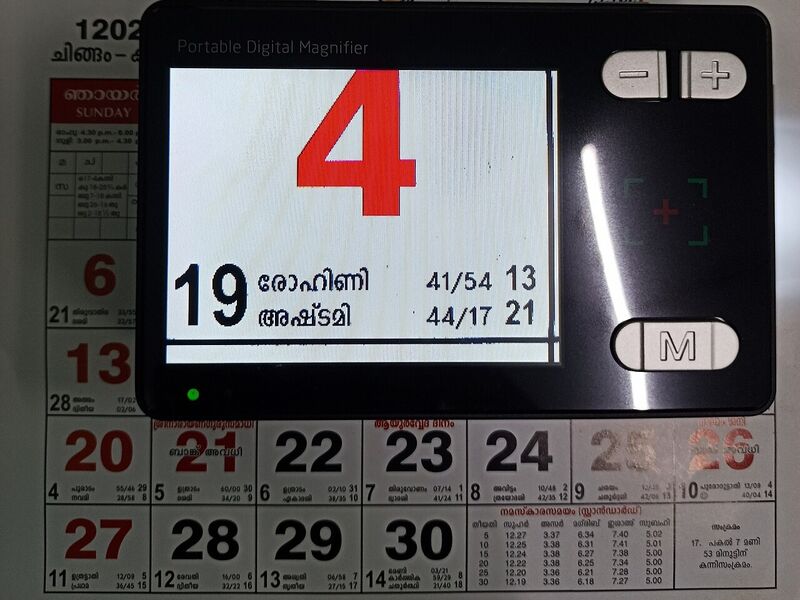
| Portable electronic magnifier | A battery-powered camera and screen held over print | Reading on the go, changing colors for contrast | Needs charging; buttons and menus may be hard to learn |
| Desktop video magnifier | Camera above a tray, image shown on a large monitor | Long reading and writing sessions at home | Takes desk space; the most complex to set up |
| Phone, tablet or computer settings | Built-in zoom, larger text, higher contrast and read-aloud | Screens the person already uses | NEI lists these among the first changes to try for minor vision loss |
The power, lens size and light level differ widely between products. Check the label or the maker's specification sheet for magnification and field of view, and try before buying when you can.
How to choose a magnifier for an older adult
- Name the task first. Reading a whole letter, threading a needle and seeing a bus number need different tools. Many people end up with two: one for the chair and one for the pocket.
- Match the eye condition. Central vision loss, side vision loss and blurry vision affect what kind of enlargement helps. That judgment belongs to the eye doctor or vision rehabilitation specialist.
- Test grip and posture. If hands shake or grip is weak, a stand or electronic magnifier may be easier than a handheld lens. Check the person can sit comfortably at the distance the device needs.
- Look at the light. NEI suggests brighter lights and anti-glare sunglasses for minor vision loss. A built-in light helps in dim rooms; a desk lamp aimed at the page from the side can help too.
- Check controls on electronic models. Large buttons, a simple on-off switch, a clear battery indicator and contrast modes (for example, light text on a dark background) are worth comparing in person.
- Borrow before you buy. Every state has an assistive technology program backed by federal ACL grants. ACL says these programs let people compare devices hands-on and borrow one for a limited time to see if it suits them.
Costs, Medicare and other help
Original Medicare. Medicare.gov says Part B does not usually cover eyeglasses or contact lenses; it pays for one pair of standard-frame glasses or one set of contacts after each cataract surgery that implants an intraocular lens. Magnifiers get no such exception. A Medicare policy article for refractive lenses, published in the CMS coverage database (revision effective October 1, 2020), states that low vision aids are denied as noncovered because the prosthetic lens benefit is limited to people whose natural lens is missing from birth or was surgically removed. Plan to pay for a magnifier yourself unless other coverage applies.
Therapy, not devices. Outpatient occupational therapy is a Part B benefit once a provider certifies it is needed; Medicare.gov says it includes help with daily activities and carries 20% coinsurance after the deductible. Ask the eye doctor whether vision rehabilitation in your area is billed this way.
Medicare Advantage. Medicare.gov notes these plans may offer extra vision benefits that Original Medicare lacks. Call the plan and ask specifically about low vision aids.
Veterans. VA health care covers routine eye exams for enrolled veterans, and the VA's Blind Rehabilitation Service offers assessment, training and assistive technology to eligible veterans whose vision loss cannot be corrected with regular glasses and who struggle with daily tasks. Ask the VA eye clinic for a referral.
Loans and reuse. Your state AT program, listed in the AT3 Center directory, may lend or pass on a used magnifier. Prices for new devices vary too much by type to quote, so we have not listed any.
Care. Keep lenses clean with the cloth or method the maker recommends, store handheld lenses in their case to avoid scratches, and charge electronic magnifiers on a set schedule.
Limitations and safety
- A magnifier does not treat eye disease. NEI says low vision is usually permanent. Regular eye exams still matter, and any sudden change in sight needs prompt attention from an eye doctor.
- It does not fix every task. Magnification helps with detail; it does little for side vision loss when walking around the home. NEI lists home setup for safe movement as part of vision rehabilitation.
- Put the lens down before walking. Getting up with a magnifier in hand leaves one hand off the furniture or walker and attention on the lens.
- Medicine labels. If dosing instructions are still hard to read with a magnifier, ask the pharmacist what options they offer, and have someone double-check new prescriptions.
Poor vision also links to falls. NIA's falls guidance advises having eyes and hearing tested, since even small changes in sight are tied to a higher risk of falling, and taking time to adjust to new glasses.
How a caregiver can help with everyday reading and seeing
Good habits and a well-lit setup often decide whether a magnifier gets used or ends up in a drawer. A family member or companion caregiver can:
- Create a reading station. A firm chair, a table at elbow height, a bright lamp positioned to avoid glare, and the stand magnifier left in place.
- Place magnifiers where they are needed. One by the mail, one in the kitchen drawer for packet instructions, one by the medicine cabinet.
- Charge and check. Put electronic magnifiers on the charger at the same time each evening and test the light on handheld lenses weekly.
- Adjust screens. Turn on larger text, zoom and higher contrast on the phone and tablet, which NEI suggests for minor loss.
- Bring printed matter to life. Read mail aloud, help with large-print books and puzzles, and go to vision rehabilitation sessions to learn the same techniques.
- Keep walkways clear and well lit so the person can move around without relying on a lens.
More ideas for staying busy with weaker eyesight are in our guides to large-print games and puzzles and easy-to-use tablets. When an older relative would welcome a regular visitor to read the post aloud, run errands and come along to eye appointments, consider companion care. Caregivers on CaregiverConnect apply to the job you list at no charge, and the hiring decision is yours alone. We have not vetted anyone, so the safety page lists what to check. When the time comes, you can find a caregiver near you here.
Frequently asked questions
What kind of magnifier is best for macular degeneration?
No single type suits everyone. Age-related macular degeneration affects central vision, and the right magnifier depends on how much sight remains and the task. NEI recommends asking an eye doctor about vision rehabilitation, which includes training with magnifying devices.
Does Medicare cover magnifiers for low vision?
No. A Medicare refractive lens policy article says low vision aids are denied as noncovered. Part B does cover outpatient occupational therapy when a provider certifies the need, and some Medicare Advantage plans add vision benefits.
Is a handheld or a stand magnifier easier for seniors?
A stand magnifier holds the lens at a set height, so it suits longer reading and shaky hands. A handheld lens is better for quick tasks away from home. Many people keep one of each.
What is an electronic video magnifier?
It uses a camera and a screen to show print larger, often with contrast options. Portable versions run on batteries; desktop versions use a monitor. They are more complex, so try one at a state AT program demonstration first if you can.
Can a phone be used as a magnifier?
Many phones and tablets have zoom, larger text and high-contrast settings, and NEI lists changing these settings among the first steps for minor vision loss. They work best for people already comfortable with the device.
Where can I try a magnifier before buying?
State assistive technology programs offer device demonstrations and short-term loans. Find your state program in the AT3 Center directory. Vision rehabilitation services may also let you try different types.
Sources
- National Eye Institute, Low Vision
- National Eye Institute, Vision Rehabilitation
- eCFR, 21 CFR 886.5540 Low-vision magnifier (FDA classification)
- eCFR, 21 CFR 886.5870 Low-vision telescope (FDA classification)
- Medicare.gov, Eyeglasses and contact lenses
- CMS Medicare Coverage Database, Refractive Lenses policy article A52499
- Medicare.gov, Occupational therapy
- Medicare.gov, What's not covered by Original Medicare
- VA, Vision care
- VA Rehabilitation and Prosthetic Services, Blind and Visual Impairment Rehabilitation Services
- ACL, Assistive Technology (State AT programs)
- AT3 Center, State AT program directory
- NIA, Falls and Fractures in Older Adults (read via web.archive.org copy of 2026-07-30)
Ready to find a caregiver?
Post what you need for free and see which caregivers near you apply.