Rollators for Seniors: Seats, Brakes and Sizing
A rollator is a wheeled walker with hand brakes, and usually a seat and a basket. It suits some older adults very well and others not at all. This guide covers rollators only: who may benefit, how to size the seat and handles, what the brakes and wheels change, what Medicare says, and how a family member or caregiver can make daily use safer.

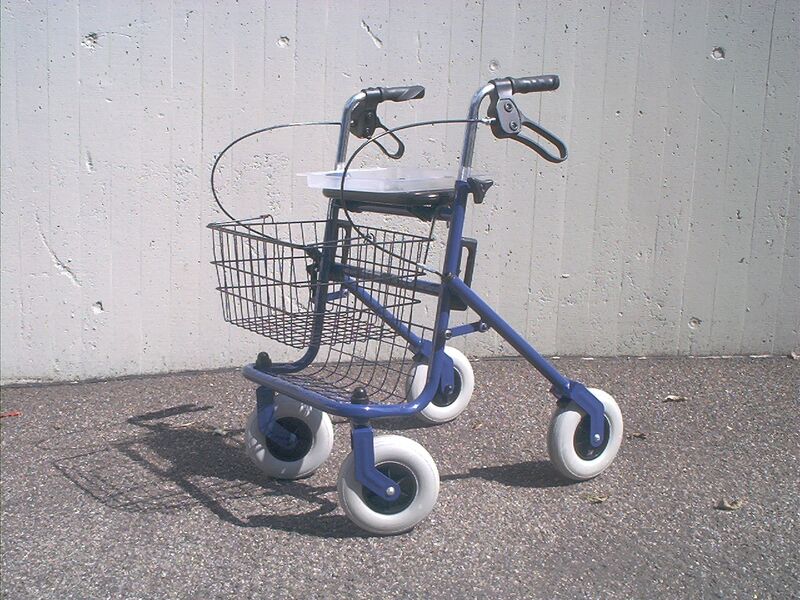

Who may benefit from a rollator
An Elder Care sheet for clinicians, published by the Arizona Center on Aging in 2023, recommends a four-wheeled rollator for people who need a walker for balance but not to carry their body weight. In practice that often means someone who walks reasonably well but wobbles, tires on longer outings, or wants a place to sit down partway through a walk. People who must lean hard on a frame to stay upright are usually steered toward a standard walker instead; our walker vs. rollator comparison sets out that choice in detail.
An assessment before buying is worthwhile. According to MedlinePlus, a doctor or therapist can guide the choice of aid, and certain aids call for decent balance or arm strength. ChoosePT, run by the American Physical Therapy Association, cautions against borrowing a relative's walking aid and says no referral is needed to ask a PT for a quick check of falls risk. Ask for one if the person has fallen recently, is recovering from surgery, gets dizzy on standing, or has trouble with grip or memory, since rollator brakes depend on both.
How we wrote this guide
We have not tested any rollator. This page carries no affiliate links, nobody paid to be included, and we do not rank brands or models. Our material: Medicare.gov and CMS coverage documents, MedlinePlus from the National Library of Medicine, CDC falls data, ChoosePT, the Arizona sheet mentioned above, VA prosthetics pages and ACL's assistive technology pages. Where we quote a weight limit or a measurement, it comes from a manufacturer's published spec page that we read on November 3, 2026, used only to show the typical range.
Types of rollator compared
| Type | Seat | Typical wheel size | Weight limit (examples read Nov. 3, 2026) | Worth knowing |
|---|---|---|---|---|
| Three-wheel rollator | None | 7.5 in. on the example checked | 300 lb on one maker's deluxe three-wheel model | Narrower and lighter (14 lb on that model); no rest stop on long walks |
| Standard four-wheel rollator | Yes, fixed height | 7.5 in. on the example checked | 350 lb on the standard model checked | 21-inch seat and an 18.5 lb frame on the standard model checked |
| Height-adjustable four-wheel rollator | Yes, adjustable | 6 in. on the example checked | 300 lb on the example checked | Seat set from 18 to 22 in. in 1-inch steps; handles 29.5 to 38 in. |
| Heavy-duty (bariatric) rollator | Yes, wider | 8 in. on the example checked | 500 lb on the example checked | Seat 18 in. wide; frame 26 lb, so heavier to lift into a car |
| Rollator and transport chair combination | Yes, used as a chair seat | Varies | Check the label | Walk part of the way, be pushed the rest (Arizona handout); a different product from an ordinary rollator |
The figures are from Drive Medical's U.S. product pages, shown as neutral examples of what spec sheets list, not as recommendations. Other makers publish different numbers, so read the label or manual of the exact model before you buy.
How to choose a rollator: fit, features and safety
Handle height
ChoosePT puts the top of a walking aid at about wrist height when the arms hang loosely, with a slight bend at the elbow when holding on, and says the user should not have to bend forward at the waist to reach it. Check this with the person standing in the shoes they wear most days. Handle ranges vary widely, from 29.5 to 38 inches on one adjustable model to 30 to 34 inches on another, so very tall or short users should confirm the range first.
Seat height and width
Spec sheets list seat-to-floor height; the models we read ranged from 18 to 22 inches. A seat that is too high or too low makes sitting and standing harder, so try sitting on it before buying where possible, and ask the therapist which height suits the person's leg length. Heavier users should look at seat width as well as the weight limit.
Brakes
Rollator brakes are worked by hand from the handles and usually have a locking (parking) position. The Arizona handout warns that a rollator can roll away from its user and that people need good coordination to control it. Before choosing one, watch the person squeeze and lock the brakes several times. If that is a struggle, raise it with the therapist.
Wheels: indoor or outdoor
Smaller casters (6 inches on the models checked) keep the frame compact for hallways and kitchens. Larger ones (7.5 to 8 inches) are marketed for indoor and outdoor use and ride over cracks and grass more easily. Think about where most walking happens: a narrow apartment, a long driveway, or store aisles.
Three wheels or four
A three-wheel frame turns in tighter spaces and weighs less but has no seat. A four-wheel frame gives a seat and a wider base. If the person needs to rest often, a seat usually matters more than compactness.
Folding and lifting
Frame weights on the pages we read ran from 14 to 26 pounds. Ask who will fold it and lift it into a car, and try it.
Rollator costs, Medicare coverage and maintenance
On its walker coverage page, Medicare.gov names rollators among the walkers Part B pays for when a person qualifies. Rollators count as durable medical equipment (DME), so these conditions apply:
- A doctor or other treating provider writes an order saying the person needs it at home for a medical reason.
- It comes from a supplier enrolled in Medicare. Ask whether the supplier accepts assignment; one that does not may charge more.
- Once the Part B deductible for the year is met, the user's share is 20% of what Medicare approves.
- Medicare's DME booklet says it buys, rather than rents, inexpensive or routinely bought items such as walkers.
- Any Medicare-approved supplier may repair a walker the person already owns.
Medicare Advantage plans must cover the same categories of DME as Original Medicare, but the plan decides which suppliers you use and what you pay. Veterans enrolled in VA health care with a medical need can ask their VA provider about mobility aids through VA's Prosthetic and Sensory Aids Service. Every state has an assistive technology (AT) program backed by an ACL grant; these programs demonstrate devices, lend them for short trial periods and pass on reused equipment, though the mix differs by state; find yours on the AT3 Center's directory. We have not listed prices because none of these sources gives one.
Maintenance: check brakes, wheels and the seat fastenings regularly, keep the wheels free of hair and grit, and stop using the frame if a brake no longer holds. A Medicare-approved supplier can repair a covered one.
Rollator limitations and risks
- Not for weight bearing. The Arizona handout is clear that a rollator is for balance. Someone who leans their full weight on it may push it out from under themselves.
- Brakes are not automatic. The user has to apply them. A rollator does not slow itself on a slope.
- The seat is not a wheelchair. Lock the brakes and back the frame against something solid before sitting. Never push anyone who is sitting on a rollator seat; the Arizona sheet links this to bad falls, and a wheelchair or transport chair is the tool for that job.
- Poor fit causes harm. ChoosePT cites research linking more than 47,000 emergency-treated falls to the improper use or poor fit of walking aids.
- A rollator does not remove fall risk. CDC figures put falls at more than a quarter of older people every year, and a first fall makes a second twice as likely. The frame is one part of a plan that also covers footwear, lighting and clutter.
How a caregiver can help with daily rollator use
- Recheck handle height each week and after any adjustment or new shoes.
- Before each walk, squeeze both brakes and test the parking lock on a flat floor.
- Walk on the person's weaker side for the first few weeks, close enough to steady them.
- Coach the sit-down routine every time: park, lock, back up until the legs touch the seat, reach back, sit. Reverse it to stand, using an armchair rather than pulling on the rollator. MedlinePlus advises against pulling on or tilting a walker to stand.
- Pack the basket lightly so the frame does not tip; carry heavy shopping yourself.
- Plan outings with rest stops and smooth routes; avoid steep ramps unless the person has practiced them with a therapist.
- Note any near-falls, new dizziness or reluctance to walk, and pass them on to the doctor or therapist.
If the family needs someone for walks, errands or transfers on a regular schedule, a mobility assistance caregiver can do this, and a companion caregiver can come along to appointments and shops. On CaregiverConnect a family posts the job at no charge and caregivers respond to it themselves; the hiring decision stays with you. Because the site does no background screening, work through the safety checklist first, then find a caregiver near you.
Frequently asked questions
What is the right seat height for a rollator?
None of the official sources sets a single number. Spec sheets we read list seat heights of 18 to 22 inches, and one adjustable model moves in 1-inch steps from 18 to 22. Try sitting on it before you buy and ask a physical therapist which height suits the person.
Is a 3-wheel or 4-wheel rollator better for seniors?
It depends on space and stamina. A three-wheel frame is narrower and lighter but has no seat. A four-wheel frame has a seat for rests and a wider base. People who tire easily usually value the seat.
Does Medicare pay for a rollator?
Yes, if the person qualifies. Medicare.gov lists rollators under its walker benefit in Part B. A provider has to order it for home use, the supplier must be Medicare-enrolled, and the person's share is 20% once the deductible is met.
Can someone push a person sitting on a rollator?
No. The Arizona sheet says a rider being pushed on the seat risks a bad fall with a head injury. If being pushed is the need, get a transport chair or wheelchair instead.
What weight can a rollator hold?
Check the label of the exact model. On the spec pages we read, the regular four-wheel models were rated at 300 or 350 pounds and a heavy-duty model at 500 pounds.
Are big wheels better on a rollator?
Larger casters (7.5 to 8 inches) are sold for indoor and outdoor use and handle rough ground more easily. Smaller ones keep the frame compact for tight indoor spaces.
Sources
- Medicare.gov, Walkers (includes rollators; eligibility, costs, repairs)
- Medicare.gov, Medicare Coverage of Durable Medical Equipment & Other Devices (CMS Product No. 11045, PDF)
- CMS, NCD 280.3 Mobility Assistive Equipment
- University of Arizona Center on Aging, Elder Care: Choosing the Correct Walker (2023, PDF)
- MedlinePlus, Using a walker
- MedlinePlus, Mobility aids
- APTA ChoosePT, Tips to safely use walking aids
- APTA ChoosePT, Physical therapy guide to falls
- CDC, Facts about older adult falls
- VA Rehabilitation and Prosthetic Services, About PSAS (eligibility)
- ACL, Assistive technology (state AT programs)
- AT3 Center, Find a state assistive technology program
- Drive Medical, Adjustable Height Rollator, 6" casters (spec page, read 2026-11-03)
- Drive Medical, Durable 4 Wheel Rollator, 7.5" casters (spec page, read 2026-11-03)
- Drive Medical, Go-Lite Bariatric Steel Rollator (spec page, read 2026-11-03)
- Drive Medical, Deluxe 3 Wheel Aluminum Rollator (spec page, read 2026-11-03)
Ready to find a caregiver?
Post what you need for free and see which caregivers near you apply.