Wheelchairs for Seniors: Manual, Transport and Power
A wheelchair can give an older adult back the ability to get around the house, go out and save energy for the things they enjoy. The three common kinds, manual, transport and power, suit very different people. This guide sets out the differences, the measurements to check, how Medicare decides, and the daily routines that keep a wheelchair user safe and comfortable.


Who may benefit from a wheelchair
Medicare's April 2026 fact sheet on wheelchairs and scooters describes the person it has in mind: someone whose health makes moving around the home significantly difficult, and who cannot manage daily activities such as bathing, dressing, getting in and out of bed or a chair, or using the bathroom even with a cane, crutch or walker.
Ask for a clinical assessment before choosing. CMS's coverage rules for mobility equipment (NCD 280.3) work through the same questions a doctor or therapist will ask: whether a fitted cane or walker would be enough, whether memory, judgment or eyesight limit safe use, whether a caregiver is reliably available, whether the arms are strong enough to push a manual chair through a normal day, and whether the layout and floors of the home allow a wheelchair at all. The VA, for example, says Veterans can start by asking their medical provider for a consultation, and that VA provides assessment, funding, training and follow-up for mobility devices.
How we wrote this guide
We have not sat in, pushed or tested any wheelchair, we earn nothing from sales, and no company paid for a mention. We do not rank models. The guide draws on Medicare.gov, two official Medicare booklets, CMS national coverage determinations, a VA directive on wheeled mobility devices, MedlinePlus caregiving instructions, ACL and the AT3 Center. Spec figures come from manufacturer pages read on November 3, 2026, quoted as examples only.
Manual, transport and power wheelchairs compared
| Type | Who moves it | Seat widths and weight (examples read Nov. 3, 2026) | Weight capacity | Main trade-offs |
|---|---|---|---|---|
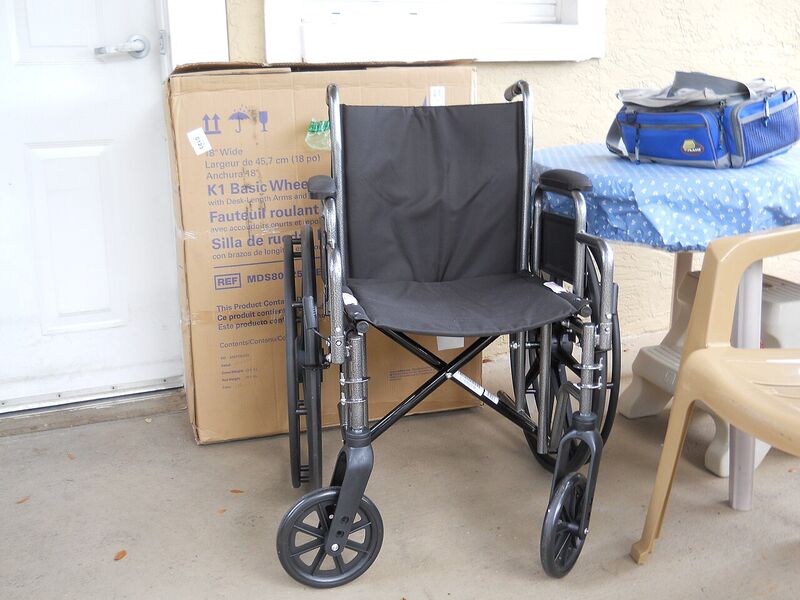
| Standard manual wheelchair | The user, with large rear wheels, or a helper pushing | 16, 18 or 20 in. seats on one common model; seat-to-floor 17.5 to 19.5 in. via a dual axle | 250, 300 or 350 lb across that model's sizes | Self-propelled or pushed; heavier to lift into a car |
| Transport chair | A companion pushes; small wheels all round | 17 or 19 in. seats; 19 lb frame on one aluminum model | 300 lb on that model | Light and compact; the rider cannot wheel themselves |
| Power wheelchair | The user, with a joystick or other control | Varies widely; four to six wheels on the ground (VA definition) | Medicare groups: standard up to 300 lb, heavy duty 301 to 450, very heavy duty 451 to 600, extra heavy duty 601 or more | Needs charging, space to turn and a way to transport it; prior authorization for many models under Medicare |
Manual and transport figures are from Drive Medical spec pages, used only as neutral examples. Power wheelchair weight groups come from the prior authorization tables in Medicare's fact sheet. Always confirm the capacity printed on the exact chair.
How to choose a wheelchair: fit, features and safety
Seat width and depth
Seat sizes are listed in inches (for example 16, 18 or 20 wide). MedlinePlus stresses that the chair must be the right size for its user, so have a therapist or supplier measure the person rather than guessing.
Seat height
Some chairs let you change the seat-to-floor height, for example from 19.5 down to 17.5 inches by moving the rear axle. Ask the therapist which height the person needs.
Who will push?
Medicare's fact sheet says a manual chair may suit someone who cannot use a cane or walker safely but has enough upper-body strength, or a person with a helper. A transport chair only makes sense if someone will always be there to push.
Arms, footrests and brakes
Check whether the arms and footrests swing away or come off; MedlinePlus has caregivers move the footrests aside before every transfer. Wheel locks must hold the chair still when someone leans on it.
The home
Measure doorways, bathroom space and turning room. Medicare requires a doctor or supplier to verify the chair can be used inside the home, for example that it fits through the doors.
Cushion
MedlinePlus advises a foam or gel cushion that fits the chair and warns against donut-shaped cushions.
Wheelchair costs, Medicare coverage and maintenance
Part B pays for manual and power wheelchairs as durable medical equipment when every condition in Medicare's fact sheet is met, including:
- the treating doctor submits a written order stating a medical need for the chair for use in your home;
- the person can safely operate it and get on and off, or always has someone available to help;
- the doctor or the DME supplier has confirmed it can be used in the home;
- both the doctor and the supplier accept Medicare.
Power chairs: a face-to-face exam with the doctor comes first, and many power wheelchair models need prior authorization, which the supplier requests. Medicare may deny it if information is missing or it finds the chair is not medically required; a denial can be appealed.
Rent or buy: Medicare's DME booklet says it rents more expensive items such as wheelchairs for 13 months of continuous use, after which the supplier must transfer ownership. The fact sheet notes you may have to rent a manual chair first. While a chair is rented, the supplier must keep it repaired.
Your share: after the Part B deductible, 20% of the Medicare-approved amount if the supplier accepts assignment; more if it does not.
Other help: Medicare Advantage plans must cover the same DME categories but set their own suppliers and costs. A VA directive says Veterans with short-term needs are generally prescribed basic manual chairs, while long-term needs may lead to customized manual or power chairs. Under section 1915(c), states run their own Medicaid waiver programs for long-term care at home, so what they include varies; the state Medicaid office can say whether a chair is part of yours. State AT programs (via the AT3 Center) may lend or pass on reused chairs.
Watch for fraud: Medicare says warning signs include offers of a "free" wheelchair, cash or a waived copayment, or a doctor you do not know ordering one for you.
Wheelchair limitations and risks
- Pressure injuries. Long sitting puts skin at risk. MedlinePlus says the user or caregiver should shift weight, leaning forward and to each side, every 15 to 20 minutes, and have the chair's fit checked once or twice a year or after weight changes.
- Transfers need a plan. MedlinePlus tells caregivers to think through each step before starting and to get help if needed; a person who cannot stand on at least one leg needs a lift.
- Power chairs and interference. In a 1993 letter to manufacturers, the FDA said it had received reports of powered wheelchairs moving uncontrollably near certain radio frequencies. Follow the manual's guidance on phones and radios.
- Outdoor-only use is not enough for Medicare. Its rules center on mobility inside the home.
How a caregiver can help: transfers and daily care
MedlinePlus sets out a bed-to-chair transfer for people who can stand on at least one leg (otherwise, a lift is needed):
- Clear rugs, park the chair beside the bed at a slight angle, lock the brakes and swing the footrests aside.
- Help the person sit on the edge of the bed for a few moments in case they feel dizzy.
- Put on a gait belt if you have one. They may hold you or the chair, but not around your neck.
- Bend your knees, keep your back straight, and pivot together toward the seat.
- If they start to fall, lower them to the nearest flat surface and tell their health care provider.
Day to day, a caregiver can also run weight-shift reminders, check skin each day, keep tires inflated and brakes adjusted, charge a power chair every night and keep routes clear.
If transfers are becoming hard to do alone, a mobility assistance caregiver can take on transfers and outings, and personal care covers bathing, dressing and toileting. CaregiverConnect charges nothing to post a job, caregivers contact you directly, and we take no commission. We do not background-check caregivers, so use the safety guide, then find a caregiver near you.
Frequently asked questions
What is the difference between a wheelchair and a transport chair?
A standard manual wheelchair has large rear wheels the user can push. A transport chair has small wheels all round and must be pushed by someone else; it is lighter, about 19 pounds on one aluminum model we checked.
Will Medicare pay for a wheelchair for an elderly parent?
Part B can, if a doctor orders it for use in the home, the person cannot manage daily activities with a cane or walker, they or a helper can operate it safely, it fits the home, and the doctor and supplier accept Medicare. The person pays 20% after the deductible.
Does Medicare cover a wheelchair only used outside the house?
Medicare's rules are built around need inside the home. Its fact sheet requires a written order for use in your home and confirmation the chair can be used there.
What seat width does a senior need?
It depends on hip width. Common manual chairs come in 16, 18 and 20 inch seats. Ask a therapist or supplier to measure.
How often should a person in a wheelchair shift position?
MedlinePlus says every 15 to 20 minutes, leaning forward and to each side, to help protect the skin.
Do I have to rent a wheelchair through Medicare?
Often at first. Medicare rents wheelchairs for 13 months of continuous use, after which ownership passes to you, and its fact sheet says a manual chair may have to be rented first.
Sources
- Medicare.gov, Wheelchairs & scooters coverage
- Medicare.gov, Medicare Coverage of Wheelchairs & Scooters fact sheet (CMS Product No. 11046, April 2026, PDF)
- Medicare.gov, Medicare Coverage of Durable Medical Equipment & Other Devices (CMS Product No. 11045, PDF)
- CMS, NCD 280.3 Mobility Assistive Equipment
- VA, VHA Directive 1173.06 Wheeled Mobility Devices (Dec. 13, 2021)
- VA, Assistive Technology (Rehabilitation and Prosthetic Services)
- MedlinePlus, Moving a patient from bed to a wheelchair
- MedlinePlus, Preventing pressure injuries
- FDA, Letter to powered wheelchair manufacturers on radio-frequency interference (May 1993)
- CMS, Fact sheet on the 1915(c) HCBS waiver final rule (Jan. 2014, PDF)
- AT3 Center, Find a state assistive technology program
- Drive Medical, Silver Sport 2 Wheelchair (spec page, read 2026-11-03)
- Drive Medical, Aluminum Transport Chair (spec page, read 2026-11-03)
Ready to find a caregiver?
Post what you need for free and see which caregivers near you apply.