Raised Toilet Seats and Toilet Safety Frames
Getting up from a low toilet takes leg strength that surgery, arthritis or weakness can take away. A raised seat lifts the sitting surface a few inches, and a safety frame adds arms to push on. MedlinePlus says raising the toilet seat height can help prevent falls. Here is how the options differ and how to choose and fit one.

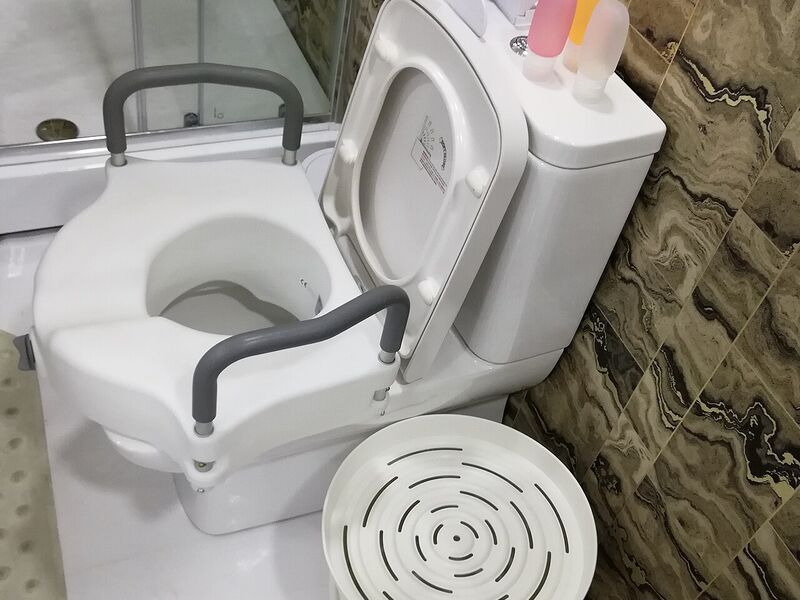

Who may benefit from a higher toilet seat
- People coming home after hip or knee surgery. MedlinePlus says a higher seat keeps you from bending the knee too much, and lists a raised seat among the things to have at home before a joint operation.
- Anyone who drops onto the seat rather than lowering themselves, or needs several tries to stand.
- People who use the sink, the towel rail or the wall to push up from the toilet.
Professional advice. If the person has hip precautions after surgery, the surgeon or physical therapist decides how high the seat must be and for how long. For general weakness, MedlinePlus suggests asking your provider about a therapist referral; a home visit lets the therapist see the actual toilet. The Safe at Home checklist that AOTA wrote with Rebuilding Together has the assessor note toilet height and the ability to go from sitting to standing; that is the question to put to the therapist.
How we wrote this guide
We did not try out any toilet seat or frame. There are no affiliate links, no sponsors and no ranked picks on this page. The guidance is based on MedlinePlus, the CDC STEADI home checklist, AOTA's Safe at Home checklist and the 2010 ADA Standards (as reference measurements only). Coverage details come from CMS and Medicare.gov. The measuring method, locking types and weight capacities quoted are from Drive Medical's catalog pages, owner's manual and "How to Choose the Right Raised Toilet Seat" sheet, all fetched on 3 November 2026; they are examples, not endorsements.
Raised seats, risers and safety frames compared
| Type | How it works | May suit | Trade-offs |
|---|---|---|---|
| Non-locking raised seat | Plastic seat that sits on the bowl rim | Short-term use, shared bathrooms | Drive's chooser sheet ranks it the least secure fit |
| Locking raised seat (knob or clamps) | Tightens against the inside of the bowl | Most longer-term home use | Must be checked for tightness routinely |
| Raised seat with arms | Locking seat with built-in armrests | People who push up with both hands | Arms are for help, not full body weight, per the manual |
| Bolted riser (hinged) | Spacer bolted between bowl and existing seat, lifting it | Households that want to keep the normal seat and lid | Drive's sheet rates bolted risers the most secure; harder to remove |
| Toilet safety frame | Armrest frame bolted under the toilet seat or standing on the floor | People who need arms but not extra height | Width must clear the person's hips; check fit on both sides |
| Taller toilet | Replacing or raising the toilet itself | Permanent need | A plumbing job; AOTA's checklist lists "raising toilet at the base" as one option |
Typical capacities. Drive Medical's raised toilet seat catalog lists 250 to 400 pounds, mostly 300, and its toilet safety frames and rails 250 to 300 pounds. The 5-inch elongated locking seat we looked at is rated 300 pounds. Always check the capacity on the product itself.
A bedside commode is another route. MedlinePlus notes a commode chair can be used instead of a toilet.
How to choose: height, bowl shape and fit
1. Work out the height you need
Drive's chooser sheet gives a simple calculation. Measure the length of the person's lower leg at the back, from the floor up to the knee crease, and add 2 inches. Then measure the toilet bowl height without the seat and lid. The difference is the raise needed; round an odd number up. Its worked example: a 19 inch leg plus 2 is 21, minus a 17 inch bowl, so a 4 inch seat. For comparison, the ADA standards set an accessible toilet seat at 17 to 19 inches from the floor (15 to 19 in residential units).
2. Check the bowl shape
Toilets are round or elongated. Drive's sheet says to measure from the front center of the bowl to the center of the seat bolt holes; its figures are about 17 inches for round and 18.5 inches for elongated. A seat for the wrong shape will not lock properly.
3. Decide on features
- Lock. Choose a locking type for anyone who leans or shifts. Non-locking seats can slide.
- Arms. Helpful for standing; measure the space between the toilet and any side wall or vanity first.
- Lid and hinge. A hinged seat lifts for cleaning and for other household members.
- Front and back openings make personal hygiene and cleaning easier.
- Frame width. One Drive frame adjusts between about 18 and 22.75 inches between the arms; sit the person in it before final tightening.
4. Safety checks
- Hand-tighten locking knobs only and never with tools, the manual says, as over-tightening can damage the threads.
- Check the seat is still secure before each use; weight should be centered, not perched on the front edge.
- The manual warns that the seat will not fit every toilet; confirm it sits correctly on the rim.
Medicare, other help, setup and cleaning
Medicare does not pay for raised toilet seats. The CMS DME reference list, NCD 280.1, calls raised toilet seats a convenience item and hygienic equipment, so they are denied; it also denies toilet seats in general as not medical equipment. Medicare Part B does cover commode chairs as durable medical equipment for some people, with a doctor's order; see that guide for the conditions.
Other routes to ask about: a Medicare Advantage plan's extra benefits (Medicare.gov says plans may cover things Original Medicare does not); your state's Medicaid home and community-based services waiver, since states choose which services to include; the VA's HISA benefit for veterans needing structural bathroom changes, prescribed by a VA physician; and your state's AT Act program (the AT3 Center keeps the directory), which according to ACL may lend a device for a trial or pass on reused equipment.
Setup. For a locking seat, the manual's steps are: lift the seat and lid, set the rear of the raised seat around the rim, center it, then turn the knob clockwise by hand until firm. A toilet safety frame bolts on using the toilet seat's own bolts, so the seat comes off first.
Cleaning. Drive's manual says to use a mild household cleaner with warm water, rinse and wipe dry, and not to use an abrasive cleaner or cloth.
Limitations and risks
- A raised seat that is not locked, or has worked loose, can shift as someone sits.
- Armrests are an aid, not a lift. The manual says not to put full body weight on them during transfers, as the unit may fail.
- A seat raised too far can be a problem of its own if the person's feet no longer rest on the floor. Measure, and ask a therapist if unsure.
- Nothing here helps with getting to the bathroom at night. The CDC suggests a nightlight on the path from bed to bathroom.
How a caregiver can help
- Before each visit, give the seat a wiggle; tighten by hand if it moves.
- Walk the person to the toilet, turn them until the backs of their legs touch the seat, and have them reach back for the arms or a grab bar before sitting.
- When they stand, follow any technique their therapist has taught, and stay at their side ready to steady them.
- Keep toilet paper within reach of the seated person; the AOTA checklist mentions adapting or moving the holder.
- Clean the seat and check under it for spills.
Regular help with toileting is personal care, and support for walking and transfers is mobility assistance. Posting on CaregiverConnect is free and you do the hiring; no one is background-checked by us, so work through the checks on our safety page before an interview. When you are set, find a caregiver near you.
Frequently asked questions
How do I know what height raised toilet seat to buy?
One manufacturer's method: measure from floor to the back of the knee, add 2 inches, and subtract the bowl height without the seat. The result, rounded up, is the raise needed. A therapist can confirm it, especially after hip surgery.
Does Medicare cover a raised toilet seat?
No. CMS lists raised toilet seats as a convenience item and hygienic equipment and denies them. A commode chair may be covered under Part B for people who meet the conditions.
What is the difference between a raised toilet seat and a toilet safety frame?
A raised seat adds height. A safety frame adds armrests on both sides without changing height. Some people use both; one manufacturer suggests pairing a frame with a seat that has no arms.
Are raised toilet seats safe?
Locking models fitted to the correct bowl shape and checked regularly are the more secure choice. Do not use the arms to take full body weight, and stop using a seat that moves.
Will a raised toilet seat fit an elongated toilet?
Only if it is made for elongated bowls. Measure from the front of the bowl to the seat bolt holes: about 18.5 inches suggests elongated and about 17 inches round, per one maker's sheet.
How long do you need a raised toilet seat after hip replacement?
Your surgeon or physical therapist will say. MedlinePlus tells hip and knee patients to plan for a raised seat at home; the length of time is an individual decision.
Sources
- MedlinePlus, Bathroom safety for adults
- MedlinePlus, Getting your home ready - knee or hip surgery
- CDC STEADI, Check for Safety brochure (read via web.archive.org copy of 2026-10-11)
- AOTA and Rebuilding Together, Safe at Home Checklist (PDF)
- U.S. Access Board, 2010 ADA Standards for Accessible Design (section 604.4)
- CMS, NCD 280.1 Durable Medical Equipment Reference List
- Medicare.gov, Commode chairs coverage
- Medicare.gov, Compare Original Medicare and Medicare Advantage
- Medicaid.gov, Home and Community-Based Services 1915(c) (read via web.archive.org copy of 2026-10-09)
- VA, Home Improvements and Structural Alterations (HISA)
- ACL, Assistive Technology programs
- AT3 Center, state AT program directory
- Drive Medical, Raised Toilet Seats catalog (weight capacity filter), example only
- Drive Medical, Premium Plastic Raised Elongated Toilet Seat with Lock: spec page, owner's manual and How to Choose sheet, example only
- Drive Medical, Toilet Safety Frame spec page and manual, example only
Ready to find a caregiver?
Post what you need for free and see which caregivers near you apply.