Tub Transfer Benches: How They Work and Who They Help
Climbing into a bathtub means balancing on one leg for a moment while the other swings over the wall onto a wet surface. A tub transfer bench takes standing out of that move: two legs stand outside the tub and two inside, so the person sits down on the dry side and shifts across. This guide explains how the benches work, how they differ from a shower chair, and what to check before buying one.

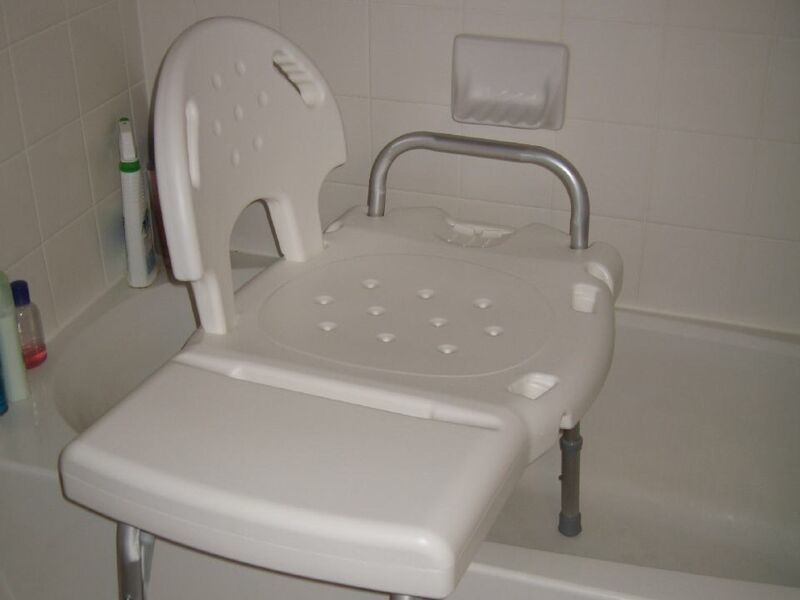

How a tub transfer bench works
The bench is longer than the tub is wide. Its outer legs stand on the bathroom floor and its inner legs stand on the tub floor, usually on suction feet; Drive Medical's assembly sheet for one model says to place the legs with suction cups into the tub. The person:
- backs up to the outside end until they feel it behind their legs, and sits;
- slides or scoots sideways along the seat toward the middle of the tub;
- lifts one leg, then the other, over the tub wall while seated;
- washes sitting down, often with a hand-held shower head;
- reverses the sequence to get out.
That order is a general outline only. Which leg to lift first, and how much help to give, depends on the person's strength and any surgical precautions, so have a physical or occupational therapist teach it.
Who may benefit, and when to ask a therapist
A transfer bench may help a person who:
- cannot lift a leg high enough to clear the tub wall while standing, or wobbles when they try;
- has a bathtub with a shower but no walk-in stall;
- uses a walker, which cannot go into the tub with them;
- has been told not to bend the hip past a certain angle after surgery (ask the surgeon or therapist whether a bench fits those limits).
The AOTA and Rebuilding Together home safety checklist asks an assessor to note whether the resident can step in and out of the bath and whether they can use a bath bench in the tub or shower. That is what an occupational therapist will look at. MedlinePlus says your health care provider can refer you to an occupational or physical therapist who can visit the bathroom; ask for this before buying if the person has fallen recently or is coming home from hospital.
If the person sits safely but has no trouble getting in, a simpler shower chair may be enough.
How we wrote this guide
No bench was tested for this page. We take no affiliate commission and accept no paid placement, and we do not pick or rank models. We used MedlinePlus (National Library of Medicine), the CDC's STEADI Check for Safety brochure, the AOTA/Rebuilding Together Safe at Home checklist, the 2010 ADA Standards for reference measurements, Medicare.gov, the CMS DME reference list, VA, ACL and the AT3 Center. Specifications quoted as examples come from Drive Medical's catalog and owner's manuals, read on 3 November 2026; other makers publish similar sheets.
Kinds of transfer bench compared
| Kind | Description | May suit | Watch for |
|---|---|---|---|
| Plastic bench with backrest | One-piece molded seat with drainage, back support, height-adjustable legs | Most standard tubs; people who need back support while washing | Check the backrest can be fitted on the side that matches the tub's open side |
| Padded bench | Cushioned seat and back | People with thin skin or who sit for longer | Padding must be wiped and dried after use |
| Sliding-seat bench | Seat glides along a frame so the person is moved across rather than scooting | People who cannot shift their weight sideways; carer-assisted bathing | The seat must lock before standing or sitting; heavier to lift and fold |
| Bench with commode opening | Transfer bench with a cut-out seat that can double as a commode | Households that want one item for both uses | More gaps and corners to clean |
| Bariatric bench | Wider seat and heavier frame | Larger users | Needs a larger bathroom footprint |
Weight limits. Drive Medical's transfer bench catalog lists capacities of 250, 300, 400 and 500 pounds across its models, with most at 400. Its standard plastic bench is rated 400 pounds with a seat that adjusts from 17.5 to 22.5 inches high in half-inch steps. Read the label for the exact model you are considering.
How to choose a transfer bench
Measure first
- Tub wall height from the bathroom floor to the top of the rim. The seat must sit above it.
- Floor space outside the tub. The outer legs and the person's legs and feet need room. For comparison, the ADA standards call for a clear floor area at least 30 inches wide alongside an accessible tub.
- Inside width at the bottom of the tub, where the inner legs land. Curved tubs can leave a leg resting on a slope.
- Which side the taps are on. Many benches have a back that can be fitted for left or right entry; Drive's manual for its plastic bench describes the back as reversible.
Seat height and position
Adjust the bench until both feet rest flat on the floor when seated and the bather can see and reach the controls. The ADA reference height for bathtub seats is 17 to 19 inches above the floor. All legs must be at matching settings so the seat is level, with the inner legs adjusted for the tub floor and the outer ones for the bathroom floor.
Features to compare
- Drainage holes and a seat surface that is not slippery when wet.
- Suction feet on the inner legs and rubber tips on the outer legs.
- A cut-out or slot for the shower curtain. Water can run down the curtain onto the bathroom floor, and some benches are sold with a curtain guard.
- Tool-free assembly, for families who will move it between homes.
Cost help, Medicare and upkeep
Medicare. Transfer benches do not appear in Medicare.gov's durable medical equipment list. The CMS DME reference list (NCD 280.1) denies bathtub seats, calling them comfort or convenience items and hygienic equipment rather than medical equipment. A bench is usually a private purchase.
Possible help:
- Medicare Advantage plans can offer extra benefits beyond Original Medicare, Medicare.gov says; call the plan and ask about bathroom equipment.
- Medicaid home and community-based services waivers are designed by each state, and Medicaid.gov notes states can add "other" services that support living at home.
- Veterans can ask the VA about HISA, which funds medically necessary structural changes such as roll-in showers when a VA physician prescribes them (lifetime limits of $6,800 or $2,000 on the VA page on 3 November 2026). Portable items like a bench are not HISA projects.
- State assistive technology programs, funded under the AT Act and listed by the AT3 Center, offer short-term device loans and reused equipment, according to ACL. A loan lets you try a bench in your own tub.
Upkeep. Drive's bench manual asks owners to wash it using a mild soap and warm-water rinse, then dry it off after every bath; check that rubber tips are not ripped, worn or missing and replace them straight away; confirm every height button has come fully through its hole; and keep all four legs on the floor at all times.
What a bench does not solve
- The leg lift still happens. It happens seated, but someone with a stiff hip or knee may still need a hand with each leg.
- Floor water. With the curtain tucked around the bench, some water usually reaches the floor. A non-skid mat outside the tub, which MedlinePlus recommends, matters more with a bench.
- Standing on it. The manual warns against standing on the bench. Never use it as a step.
- No support for a standing fall. CDC's Check for Safety brochure suggests grab bars next to and inside the tub for support when getting in and out; see bathroom grab bars.
- Suction feet loosen on textured or wet tub floors. Press them down before each bath.
How a caregiver can help at bath time
- Check the bench is level and the suction feet hold before the person comes in.
- Put the walker or wheelchair facing the bench, brakes on, close enough that the person can reach back for the seat.
- Guard from the side as they sit, then help lift legs over the rim one at a time if needed.
- Tuck the curtain, hand over the shower head, and check the water temperature with your hand first.
- Before getting out, dry the legs and feet while still on the bench, swing legs back over, and stand only when feet are on the mat.
Help with bathing on a regular schedule is personal care; transfers and walking support fall under mobility assistance. On CaregiverConnect you post the job, talk to caregivers directly and choose whom to hire; we do not background-check anyone, so read our safety checklist. Find a caregiver near you.
Frequently asked questions
What is the difference between a tub transfer bench and a shower chair?
A shower chair sits entirely inside the tub or stall. A transfer bench reaches over the tub wall, so the person sits down outside the tub and moves across without stepping over the side while standing.
Will Medicare cover a tub transfer bench?
Usually not. Benches are not on Medicare.gov's DME list, and the CMS equipment reference list denies bathtub seats. Ask a Medicare Advantage plan, a Medicaid waiver program or your state AT program instead.
Do transfer benches fit every bathtub?
No. Measure the rim height, the inside width at the bottom and the floor space beside the tub, and check the bench's leg adjustment range against them. Clawfoot and very deep tubs may not suit.
How much weight can a tub transfer bench hold?
It depends on the model. One manufacturer's catalog lists benches from 250 to 500 pounds, most at 400. Read the label on the bench you buy.
Can someone use a transfer bench alone?
Some people do after training. A physical or occupational therapist can practice the transfer with them and say whether they need a helper present.
Sources
- MedlinePlus, Bathroom safety for adults
- CDC STEADI, Check for Safety brochure (read via web.archive.org copy of 2026-10-11)
- AOTA and Rebuilding Together, Safe at Home Checklist (PDF)
- U.S. Access Board, 2010 ADA Standards for Accessible Design (sections 607 and 610)
- Medicare.gov, Medicare Coverage of Durable Medical Equipment and Other Devices (CMS Product No. 11045, 2/2025, PDF)
- CMS, NCD 280.1 Durable Medical Equipment Reference List
- Medicare.gov, Compare Original Medicare and Medicare Advantage
- Medicaid.gov, Home and Community-Based Services 1915(c) (read via web.archive.org copy of 2026-10-09)
- VA, Home Improvements and Structural Alterations (HISA)
- ACL, Assistive Technology programs
- AT3 Center, state AT program directory
- Drive Medical, Transfer Benches catalog (weight capacity filter), example only
- Drive Medical, Transfer Tub Bench spec page and owner's manual, example only
Ready to find a caregiver?
Post what you need for free and see which caregivers near you apply.