Bathroom Grab Bars: Placement, Installation and Types
A grab bar gives a steady handhold at the points where people lower and raise themselves in a bathroom: the toilet, the tub edge and the shower entry. The CDC's home fall checklist suggests having grab bars put in next to and inside the tub and next to the toilet. Where a bar is placed and what it is fastened to decide how useful it is.


Who may benefit from grab bars
Signs that a bathroom may need grab bars:
- The person pulls on a towel rail, a sink edge, a toilet roll holder or the shower door to stand or step.
- They push hard on their thighs to get off the toilet.
- They pause, or reach for the wall, when stepping over the tub rim or the shower lip.
- They have started to skip baths or showers.
The CDC's Check for Safety brochure frames it as a question: do you need some support when you get in and out of the tub, or up from the toilet? If yes, it suggests bars beside and inside the tub and beside the toilet.
Getting an assessment. MedlinePlus suggests that your provider can refer you to an OT or PT when you are not sure what bathroom changes are needed. A therapist who sees the person move in the actual room can say which side, what height and whether a vertical bar at the tub entry would help more than a horizontal one. Ask for this when there has been a fall or a hospital stay.
How we wrote this guide
We have not installed or tested any grab bar. Nothing here earns us a commission, nobody paid for a mention, and no bar or brand is recommended. The guidance comes from the CDC's STEADI checklist, MedlinePlus, the Safe at Home checklist from AOTA with Rebuilding Together, and the U.S. Access Board's 2010 ADA Standards for Accessible Design. Coverage facts are from the CMS durable medical equipment reference list, Medicare.gov, the VA and ACL. A few product specifications are quoted from Drive Medical's catalog pages, fetched on 3 November 2026, to show what labels typically state.
Where to put grab bars
Home bathrooms differ, so treat the ADA figures below as tested reference points. The ADA standards are written for buildings the law covers, and even for residential units they allow builders to leave bars out as long as the walls are reinforced to take them later.
| Location | What the sources say | ADA reference dimension |
|---|---|---|
| Beside the toilet | CDC: next to the toilet. MedlinePlus: one bar to help you stand from sitting | Side wall bar at least 42 in long, starting no more than 12 in from the back wall |
| Behind the toilet | Used in accessible public toilets | Rear wall bar at least 36 in long |
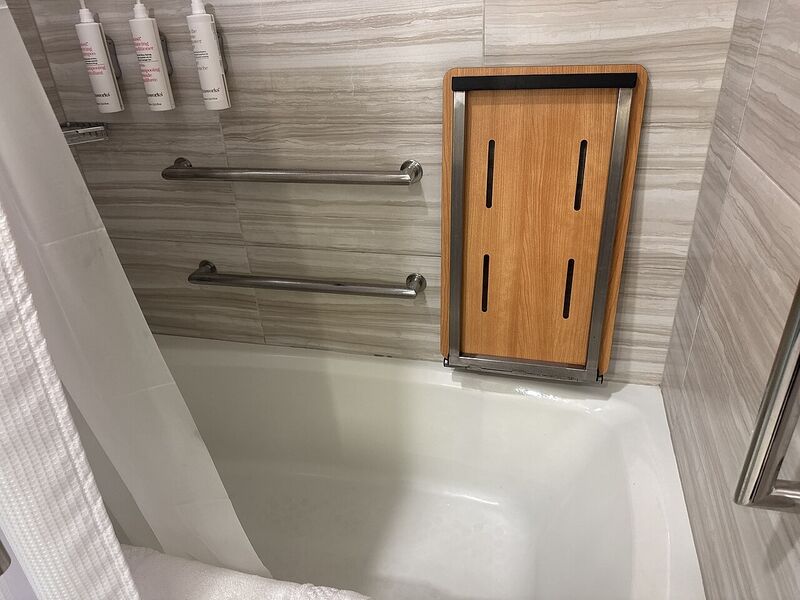
| Tub, back wall | CDC: inside the tub | Two bars: one at 33 to 36 in above the floor, a lower one 8 to 10 in above the rim |
| Tub, tap end and entry | CDC: next to the tub; MedlinePlus: one bar to get in and out | At least 24 in long at the front edge of the tap end wall |
| Shower entry | AOTA checklist: secure bars at toilet, bath and shower | Horizontal bars at 33 to 36 in to the top of the grip |
Angle. MedlinePlus says bars should be fixed vertically or horizontally on the wall, not diagonally. The ADA reference bars are horizontal. A therapist may suggest a vertical bar at the tub entry for someone who pulls themselves upright while stepping in.
Size and spacing. The ADA reference grab bar is round, between 1¼ and 2 inches across, with a 1½ inch gap between bar and wall. Bars must not rotate in their fittings, and edges must be smooth.
Types of grab bar compared
| Type | How it attaches | Load it is meant for | Notes |
|---|---|---|---|
| Fixed straight bar (smooth or knurled) | Screwed through flanges into the wall | Body weight, when anchored as the instructions require. One Drive knurled bar is labeled "supports up to 250lbs" | Lengths commonly 12 to 32 in; knurled or textured grips help wet hands |
| Fixed bar with rotating flange | As above, but the mounting flange turns | As the label states | Read the installation sheet for where its screws must go |
| Suction-cup bar | Suction pads with locking latches on smooth tile | Balance only. Drive's label says it "is not intended to support body weight" | Needs checking before every use; colored indicators on some models |
| Clamp-on tub rail | Clamps over the tub wall without tools | One Drive rail is listed at 300 lb and fits tub walls 3 to 7 in wide | No drilling; check the clamp has not loosened |
| Toilet safety frame or rail | Bolts under the toilet seat or stands on the floor | Drive lists 250 to 300 lb for its toilet safety frames and rails | Arms on both sides; covered in our raised toilet seats guide |
For reference, the ADA standards require a grab bar, its fasteners and the wall it is fixed to to withstand a 250-pound force in any direction. Ratings on retail bars vary; read the label and installation sheet.
Installation: choosing, fixing and checking
- Plan with the person present. Have them sit on the closed toilet and stand up, and mime stepping into the tub. Mark where their hand naturally goes.
- Find out what is behind the wall. Tile over drywall, fiberglass tub surrounds and plaster each need different fixings. Use the fasteners and anchors the bar's instructions specify for that wall type. The ADA's residential exception depends on reinforcement in the wall, which shows how much the backing matters.
- Consider a professional. The CDC brochure suggests having bars "put in". A handyman, contractor or a home-repair program for older adults can do it; the AOTA checklist itself was produced with Rebuilding Together.
- Test it. After fixing, pull and push hard in every direction. There should be no movement, creak or cracking tile.
- Re-check. Look for loose screws, rust or cracked grout around the flanges every few months, and test suction bars before every use.
Never substitute a towel rail, soap dish or toilet roll holder. MedlinePlus is explicit that towel racks cannot support your weight.
Cost and coverage: who pays for grab bars
Original Medicare does not. In CMS's DME reference list, NCD 280.1, grab bars get the status "Deny - self-help device; not primarily medical in nature." The bar and the installation are usually paid privately.
- Medicare Advantage: plans may include extra benefits that Original Medicare lacks (Medicare.gov). Ask the plan directly, in writing if possible, whether home safety items or installation are among them.
- Medicaid HCBS waivers: Medicaid.gov describes these as state-designed programs that may add "other" services to help people stay at home. Ask your state Medicaid agency or the local area agency on aging, reachable through the Eldercare Locator at 1-800-677-1116.
- VA HISA: VA can fund medically necessary home alterations for access to "essential lavatory and sanitary facilities" with a VA physician's prescription, VA Form 10-0103, an itemized estimate and photos of the area. When we checked on 3 November 2026, VA listed lifetime limits of $6,800 for service-connected cases (and some others) and $2,000 otherwise.
- State AT programs: ACL funds one in every state; the AT3 Center lists them. ACL says they run device demonstrations and state financing activities.
We do not give price estimates because none of the official sources we used publish them.
Limitations and safety
- A bar only helps if it is within reach at the moment balance is lost.
- A bar that is not anchored the way its instructions require may pull loose under load.
- Suction bars can release without warning if the seal fails; Drive's caution recommends a permanently mounted bar where any body weight or leverage is involved.
- Grab bars do not stop slips underfoot. The CDC advises a non-slip mat or self-stick strips on the tub or shower floor as well.
- Someone who has fallen and cannot get up needs a way to call for help; see medical alert systems.
How a caregiver can help with daily use
- Coach the person to grip the bar, not a nearby fixture, and to move slowly when standing.
- Give a quick tug to each suction or clamp-on bar before the shower starts.
- Keep bars clear of towels and robes so a hand lands on metal, not fabric.
- Wipe soap scum off textured grips so they stay grippy.
- Report any wobble to the family the same day.
When the person needs hands-on help with toileting or bathing, look for a caregiver offering personal care; for steadying on walks and transfers, mobility assistance. Read the companion vs. personal care guide before writing the job. CaregiverConnect is a free place to post and hire directly; we do not screen caregivers, so follow our safety steps. Find a caregiver near you.
Frequently asked questions
How high should a grab bar be next to a toilet?
The ADA reference height is 33 to 36 inches from the floor to the top of the bar, with a side bar at least 42 inches long. In a home, a therapist may adjust this to the person's height and how they stand.
Are suction cup grab bars safe for seniors?
They are for balance only. One manufacturer's label states its suction bar is not intended to support body weight and recommends a permanently mounted bar for leverage. Check the seal before each use.
Does Medicare pay for grab bars?
No. CMS lists grab bars as a self-help device that is not primarily medical, so Original Medicare denies them. Ask a Medicare Advantage plan, Medicaid waiver program, the VA or your state AT program.
Should grab bars be horizontal or vertical?
Either, says MedlinePlus, but not diagonal. ADA reference bars are horizontal. A vertical bar at a tub or shower entry can suit someone pulling up while stepping; a therapist can advise.
Can I install a grab bar myself?
If you can follow the installation sheet for your wall type and anchor it securely, yes. The CDC brochure suggests having bars put in, and a tradesperson is the safer choice if you are unsure what is behind the tile.
How many grab bars does a bathroom need?
MedlinePlus says you will need two: one to get in and out of the tub and one to stand up from sitting. The CDC suggests bars next to and inside the tub and next to the toilet.
Sources
- CDC STEADI, Check for Safety brochure (read via web.archive.org copy of 2026-10-11)
- MedlinePlus, Bathroom safety for adults
- MedlinePlus, Getting your home ready - after the hospital
- AOTA and Rebuilding Together, Safe at Home Checklist (PDF)
- U.S. Access Board, 2010 ADA Standards for Accessible Design (sections 604, 607, 609)
- CMS, NCD 280.1 Durable Medical Equipment Reference List
- Medicare.gov, Compare Original Medicare and Medicare Advantage
- Medicaid.gov, Home and Community-Based Services 1915(c) (read via web.archive.org copy of 2026-10-09)
- VA, Home Improvements and Structural Alterations (HISA)
- ACL, Assistive Technology programs
- AT3 Center, state AT program directory
- Eldercare Locator (ACL)
- Drive Medical, Grab Bars catalog, example only
- Drive Medical, Chrome Knurled Grab Bar spec page, example only
- Drive Medical, Suction Cup Grab Bar spec page (caution text), example only
- Drive Medical, AquaSense Multi-Adjust Bath Safety Rail spec page, example only
- Drive Medical, Toilet Safety catalog (weight capacity filter), example only
Ready to find a caregiver?
Post what you need for free and see which caregivers near you apply.