Shower Chairs for Seniors: Types and Safe Setup
A shower chair lets someone wash sitting down instead of balancing on a wet, soapy floor. MedlinePlus, the National Library of Medicine's consumer site, advises sitting on a bath chair or bench to shower and notes that the bathroom is a room where falls most often happen. This guide covers the main kinds of seat, how to pick a size, how to set one up, and who might help pay.

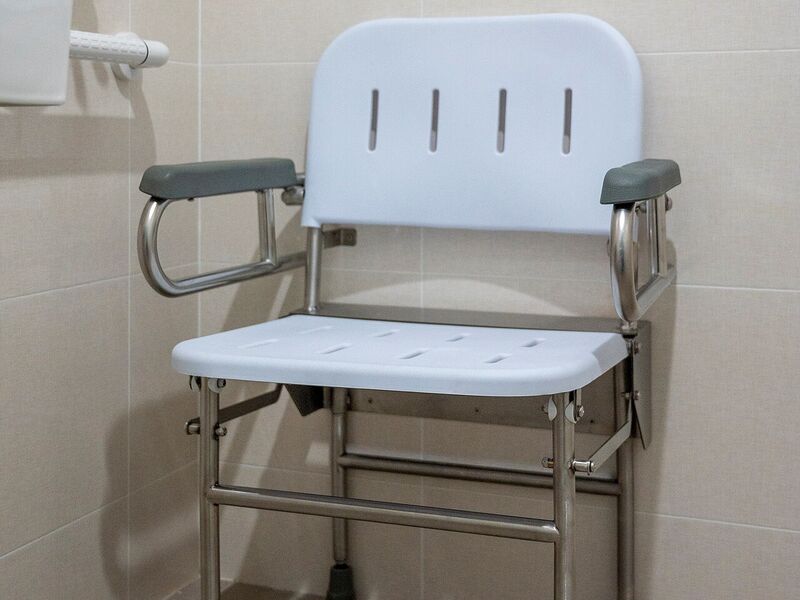

Who may benefit from a shower chair
A seat in the shower may help someone who:
- gets tired or short of breath standing through a whole shower;
- feels unsteady with eyes closed while rinsing hair, or when turning around under the water;
- is home after a hip or knee operation, when MedlinePlus lists a shower chair among the things to have ready;
- already holds on to the soap dish, the door or the curtain rail to stay upright.
When the hard part is stepping over the tub wall rather than standing, a chair that sits inside the tub does not fix that. A tub transfer bench is built for that problem.
When to get an assessment. MedlinePlus suggests asking a health care provider for a referral to an occupational or physical therapist if you are unsure what to change in a bathroom; the therapist can come to the home and look at the actual room. The home checklist that the American Occupational Therapy Association produced with Rebuilding Together asks the same questions an occupational therapist would: can the person step in and out of the bath, can they use a bath bench, and is there room for a helper. Ask for that visit after a fall, after surgery, or when you cannot tell whether a stool, a chair or a bench is the right answer.
How we wrote this guide
We did not test any shower chair. There are no affiliate links on this page and no company paid to appear on it. We do not rank or recommend models. The safety advice comes from MedlinePlus, the CDC's STEADI home checklist, the AOTA and Rebuilding Together Safe at Home checklist, and the federal 2010 ADA Standards for Accessible Design (used only as reference measurements). Coverage facts come from Medicare.gov and the CMS durable medical equipment reference list. Weight capacities and features are taken from one large manufacturer's catalog and owner's manuals (Drive Medical), read on 3 November 2026 as neutral examples of what the labels say.
Types of shower chair compared
| Type | What it is | May suit | Points to weigh |
|---|---|---|---|
| Shower stool | Small round or square seat on three or four legs, no back | Someone with good sitting balance who mainly needs a rest; tight stall showers | Nothing to lean against or push up from |
| Bath seat or chair with backrest | Wider seat, back support, adjustable legs | People who tire or slump while sitting | Takes more floor space; check it fits inside the tub |
| Chair with armrests | Backed seat plus side arms to push up from | Shower stalls, where arms help with standing up | MedlinePlus advises a seat without arms when it is placed in a bathtub |
| Swivel seat | Seat that turns on its base | People who struggle to twist to reach controls or a shelf | Moving seat; confirm it locks before sitting and standing |
| Fold-down wall seat | Seat fixed to the shower wall that folds up when not used | Shared bathrooms where a loose chair is in the way | A building job; the wall must carry the load (ADA reference seats are tested to a 250-pound force) |
| Rolling shower commode chair | Wheeled chair with an open seat, used over the toilet and rolled into a level-entry shower | People who cannot walk into the shower; roll-in showers only | Needs a step-free shower and wheel locks; ask a therapist |
Weight capacity. On Drive Medical's bath benches and stools catalog page, listed capacities run from 250 to 350 pounds, and its aluminum bath chair with back is rated 300 pounds. Heavier-duty (bariatric) seats exist. Whatever you buy, check the capacity printed on the label or in the manual against the person's weight, and leave a margin.
Size. Seat widths vary a lot between models; the aluminum chair above has a 19.25 by 11.5 inch seat. Measure the inside floor of the tub or stall and compare it with the leg footprint, not only the seat.
How to choose: fit, features and safety
Fit and measurement
- Seat height. When seated, the person's feet should rest flat on the tub or shower floor. For reference, the ADA standards put the top of a tub or shower seat between 17 and 19 inches above the bathroom floor. Many legs adjust in 1 inch steps; set all four to the same hole.
- Footprint. Drive's manual for its shower chair warns that, in a tub, the rubber tips should not touch the sides of the tub. Curved tub floors are narrower at the bottom than at the rim, so measure low down.
- Reach. Sit on a kitchen chair placed where the shower seat will go and check that the taps, the soap and a hand-held shower head are reachable without leaning.
Features worth paying attention to
- Non-slip rubber tips on every leg, and a seat with drainage holes so water does not pool.
- A backrest for anyone who tires sitting up; arms only if the setup allows them.
- Tool-free assembly is convenient, but every push-button must click fully through its hole.
- A hand-held shower head on a long hose. The AOTA checklist lists an adjustable-height hand-held head, and the ADA reference hose length is at least 59 inches.
Safety basics
- All four legs touch the floor at once, every time. Rock the chair before each use.
- Never stand on the seat to reach a shelf or the shower head. Drive's manuals print this warning in capitals.
- Put non-slip strips or a rubber mat on the tub or shower floor and a non-skid mat outside, as the CDC and MedlinePlus advise.
- MedlinePlus suggests setting the water heater to no more than 120°F to prevent burns.
Costs, Medicare coverage, maintenance and setup
Original Medicare. Medicare Part B pays for durable medical equipment (DME) a doctor orders for home use, but bath seats are not on that list. The CMS durable medical equipment reference list (NCD 280.1) marks bathtub seats as "Deny - comfort or convenience item; hygienic equipment; not primarily medical in nature." Plan on buying a shower chair yourself unless another program helps.
Other places to ask:
- Medicare Advantage. Medicare.gov says these plans may offer extra benefits Original Medicare does not cover. Ask the plan whether bathroom safety items are among them.
- Medicaid waivers. According to Medicaid.gov, states can offer a wide range of services through home and community-based services waivers and can propose "other" services that help people live at home. What is included varies by state.
- Veterans. VA's Home Improvements and Structural Alterations (HISA) benefit pays for medically necessary changes to a veteran's home, including access to bathroom facilities such as roll-in showers. The page lists lifetime amounts of $6,800 or $2,000 depending on the disability (as shown on 3 November 2026) and needs a VA prescription. It excludes removable equipment.
- State assistive technology programs. Every state has one under the federal AT Act. ACL describes device demonstration, short-term loans to try equipment before buying, and reuse of donated equipment. Find yours through the AT3 Center.
- Local services. The Eldercare Locator (1-800-677-1116) connects families with the local area agency on aging.
Maintenance. Drive's manuals say to clean with mild soap, rinse with warm water and wipe the seat dry after each use, and to replace rubber tips at once if they are ripped, worn or missing. Tips and suction feet are wear parts that the lifetime warranties exclude.
Setup in five steps. Assemble on a dry floor; set the legs to one height; place it in the tub or stall away from the drain; press down on each corner to check it is level; then do a dry run, fully clothed, with someone standing by.
Limitations and safety risks
- Getting in and out. A chair helps once the person is seated. Stepping over a tub wall or a stall lip is a separate risk; grab bars or a transfer bench address it.
- Tipping. Uneven legs, a leg resting on the tub's curved side or a missing tip can let the chair tilt.
- Standing up wet. Rising from a seat on a slippery floor can be an unsteady moment. A fixed grab bar within reach helps; a towel rail does not, because MedlinePlus says towel racks cannot support your weight.
- Burns. Someone seated may not be able to step away from water that runs hot.
- A shower chair is not a substitute for supervision for someone whose balance or memory is poor.
How a caregiver can help with showering
- Lay out towel, clean clothes and toiletries before the water goes on, so nobody reaches or twists mid-shower. MedlinePlus suggests a long-handled sponge for feet and back.
- Run the water and test it before the person sits down.
- Stand on the open side while they sit and while they stand. Let them use the grab bar; avoid pulling on their arms.
- Hand over the shower head and give privacy where it is safe, staying within call.
- Dry feet and between toes on the seat, before standing, and step them onto a non-skid mat.
- Wipe the chair dry and check the tips once a week.
Regular help with bathing is personal care. A caregiver who offers personal care can do this on a schedule; our guide to companion care vs. personal care explains why the difference matters when you hire. When someone also needs help with walking and transfers, mobility assistance covers that. CaregiverConnect lets families post a job at no cost and choose a caregiver themselves. Because we never screen or background-check applicants, read our safety page. Find a caregiver near you.
Frequently asked questions
What is the difference between a shower chair and a shower stool?
A stool has no back and is usually smaller, so it suits a narrow stall and someone with good sitting balance. A chair adds a backrest, and sometimes arms, for people who tire or need something to push up from.
Does Medicare pay for a shower chair?
Original Medicare generally does not. The CMS DME reference list classes bathtub seats as a comfort or convenience item and hygienic equipment. A Medicare Advantage plan, Medicaid waiver or state assistive technology program may help; ask each.
Should a shower chair have arms?
Arms help with standing in a stall shower. For a seat placed in a bathtub, MedlinePlus advises one without arms. A therapist can say what suits your tub.
How high should a shower chair be?
High enough that the person sits with feet flat on the floor. The ADA reference height for tub and shower seats is 17 to 19 inches from the bathroom floor; adjustable legs let you fine-tune it.
Can I use a regular plastic patio chair in the shower?
Bath seats are built with rubber tips, drainage and a labeled weight limit for wet floors. A household chair has none of that information on it, so its grip and capacity on a wet tub floor are unknown.
Who can tell us which shower seat to get?
An occupational or physical therapist. MedlinePlus says your provider can refer you, and the therapist can visit the bathroom and make recommendations.
Sources
- MedlinePlus, Bathroom safety for adults
- MedlinePlus, Getting your home ready - knee or hip surgery
- CDC STEADI, Check for Safety brochure (read via web.archive.org copy of 2026-10-11)
- AOTA and Rebuilding Together, Safe at Home Checklist (PDF)
- U.S. Access Board, 2010 ADA Standards for Accessible Design (sections 607, 609, 610)
- CMS, NCD 280.1 Durable Medical Equipment Reference List
- Medicare.gov, Compare Original Medicare and Medicare Advantage
- Medicaid.gov, Home and Community-Based Services 1915(c) (read via web.archive.org copy of 2026-10-09)
- VA Prosthetic and Sensory Aids Service, Home Improvements and Structural Alterations (HISA)
- ACL, Assistive Technology (State Grant for AT Program)
- AT3 Center, Find an Assistive Technology Act Program
- Eldercare Locator (ACL)
- Drive Medical, Bath Benches and Stools catalog (weight capacity filter), example only
- Drive Medical, Deluxe Aluminum Bath Chair spec page and owner's manual, example only
Ready to find a caregiver?
Post what you need for free and see which caregivers near you apply.